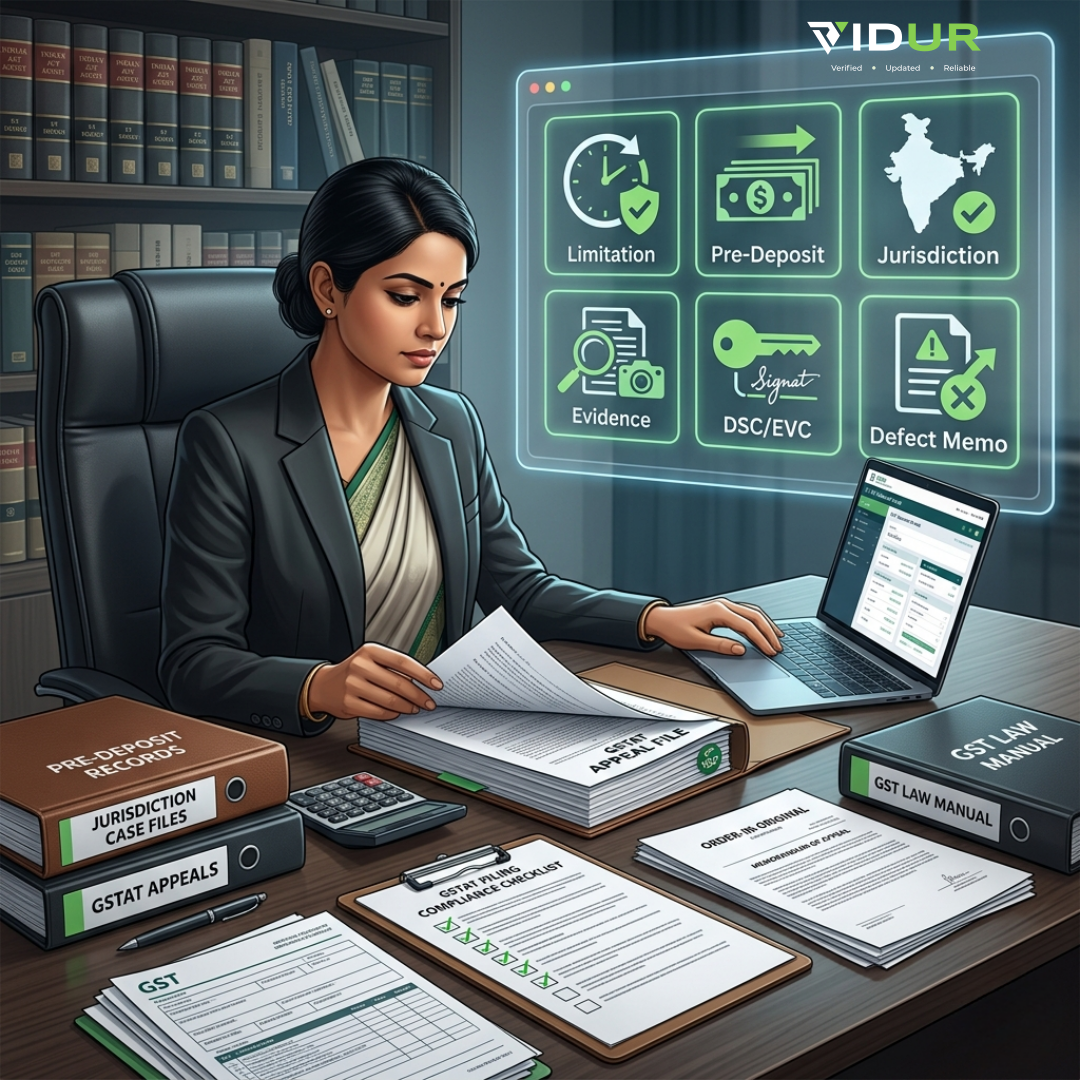


“The GSTAT is finally live, and the floodgates have opened,” a Tax Partner remarks to his legal team. “We are no longer just fighting for stays in the High Court; we are entering a marathon of merit-based adjudication. If our ITC reconciliation isn’t airtight, we aren’t just losing the credit—we’re risking a 100% penalty.”
As of May 2026, the GST landscape has shifted from “transitional friction” to “data-driven enforcement.” With the Goods and Services Tax Appellate Tribunal (GSTAT) now operational and clearing a backlog of over 2 lakh appeals, the judiciary is setting definitive precedents on Input Tax Credit (ITC) eligibility, valuation, and procedural natural justice.
For practitioners, the “wait and watch” era is over. The current trend is a move away from technical writ petitions toward substantive legal defense.
Trend 1: The “Bona Fide Buyer” Shield
The most significant trend in 2025–26 centers on Section 16(2)(c)—the provision that denies ITC to a buyer if the supplier fails to deposit the tax.
The Legal Lesson
The Legal Lesson: While the Gujarat High Court recently upheld the constitutional validity of Section 16(2)(c), the Supreme Court in landmark rulings (like Shanti Kiran India) and various High Courts have begun “reading down” these provisions.
The Trend
• The Trend: Courts are increasingly protecting buyers who have acted in “good faith.” If you can prove the transaction was genuine, the payment was made (including tax), and the supplier was registered at the time of the sale, the Department is being directed to recover from the supplier first, rather than penalizing the buyer.
Actionable Advice
• Actionable Advice: Maintain a “Vendor Compliance Log.” Simply having an invoice isn’t enough; you need proof of payment through banking channels and evidence that you verified the vendor’s filing status at the time of the transaction.
Trend 2: System-Driven Mismatches vis-a-vis Substantive Rights
We are seeing a surge in litigation regarding mismatches between GSTR-2A/2B and GSTR-3B.
The Legal Lesson
The Legal Lesson: The Calcutta High Court and others have reiterated that GSTN portal glitches or a supplier’s failure to reflect an invoice in GSTR-1 cannot be the sole basis for denying credit.
The Trend
• The Trend: “Technical or system-driven mismatches cannot defeat substantive ITC rights.” If the taxpayer has the physical invoice and proof of receipt of goods, the “reflection on the portal” is considered a procedural requirement that cannot override the statutory right to credit.
Actionable Advice
• Actionable Advice: In your scrutiny replies, always provide a Reconciliation Statement and cross-reference it with your physical purchase register.
Trend 3: The End of “Anti-Profiteering” New Cases
A major structural shift occurred on April 1, 2025, when the initiation of new anti-profiteering cases was phased out.
The Legal Lesson
The Legal Lesson:
The Trend
• The Trend: While no new cases are being started, the focus has shifted to the adjudication of pending matters. Courts are now scrutinizing the “methodology” used by the National Anti-profiteering Authority (NAA).
Actionable Advice
• Actionable Advice: For legacy cases, the defense should focus on “commensurate reduction.” If your costs (raw materials, wages, logistics) increased during the period, document these as valid commercial reasons for not lowering prices, even if GST rates were reduced.
Trend 4: Mandatory Personal Hearings (Section 75)
High Courts have become incredibly strict about Section 75(4), which mandates a personal hearing before any adverse order is passed.
The Legal Lesson
The Legal Lesson:
The Trend
• The Trend: Orders passed without a personal hearing or a specific “speaking notice” are being routinely quashed as a violation of Natural Justice.
Actionable Advice
• Actionable Advice: Always check if the “Personal Hearing” box was ticked in the portal response. If an order is passed without a hearing, it is a “jurisdictional error” that can be challenged via a Writ even if the GSTAT is available.
Trend 5: Valuation & “Cross-Charge” Controversies
With the maturation of GST, the Department is now focusing on complex valuations, especially inter-company services (Cross-Charge) and employee secondments.
The Legal Lesson
The Legal Lesson:
The Trend
• The Trend: Disputes often arise when a Head Office provides “support services” to branch offices without charging a fee. Authorities are increasingly treating these as taxable supplies under Schedule I.
Actionable Advice
• Actionable Advice: Draft formal Inter-Company Service Level Agreements (SLAs). Relying on “gentleman’s agreements” for internal cost allocations is a invitation for a high-value valuation dispute.
Navigating with Vidur AI
In GST litigation, a ruling by the Madras High Court today can become the basis of your appeal in Delhi tomorrow. However, manually tracking every “Daily Order” and “Practice Note” from the GSTAT is an impossible task for a busy practitioner.
Vidur AI serves as your litigation intelligence hub:
Real-time Update
• Real-time Update: Our legal research team integrates every landmark High Court and Supreme Court GST judgment within 24 hours of the order being uploaded.
Vast Library
• Vast Library: Access to over 150+ publications allow you to find the exact “needle in the haystack”—that one specific precedent that matches your client’s unique fact pattern.
Drafting Precision
• Drafting Precision: Use Vidur AI to structure your “Grounds of Appeal” for the GSTAT, ensuring they are aligned with the latest judicial thinking on ITC and valuation.
From Compliance to Litigation Strategy
The next two years will be defined by the GSTAT. Success will belong to those who move beyond basic filing and master the art of evidence-based litigation. Whether it is fighting a “fake invoice” allegation or defending a complex “place of supply” position, your documentation is your best defense.
Don’t enter the Tribunal unarmed. Leverage Vidur AI to build a winning litigation strategy backed by the most current judicial precedents in India.