


GSTAT appeal filing has become one of the most important workflows for CAs, GST consultants, tax advocates and litigation teams. With the GST Appellate Tribunal now moving towards a digital-first process, professionals are expected to manage multiple documents, extract facts accurately, prepare grounds of appeal, organise pre-deposit details and ensure that the appeal papers are ready for filing.
While the GSTAT portal enables online filing of appeals, applications and related documents, the actual preparation of an appeal is still a document-heavy and time-consuming task.
This is where VIDUR AI GSTAT Appeal Filing Tool helps professionals prepare appeal documents faster, in a more structured manner and with reduced manual effort.
Why GSTAT Appeal Preparation is a Time-Consuming Process
Preparing a GSTAT appeal is not just about filling a form. A professional must first understand the entire dispute journey.
This usually involves reviewing the show cause notice, taxpayer’s reply, Order-in-Original, first appeal documents, Order-in-Appeal, pre-deposit proof, grounds already taken and supporting records.
For a single appeal, the team may have to go through documents such as:
- DRC-01 and detailed SCN
- DRC-06 reply
- DRC-07 and detailed Order-in-Original
- APL-01 and first appeal set
- APL-02 acknowledgement
- GST APL-04
- Order-in-Appeal
- Pre-deposit details such as DRC-03 or credit ledger entry
- Other documents such as ASMT-10, DRC-01A, internal notes or draft grounds
The official GSTAT Help Center also lists Form GST APL-05 as the form for taxpayer appeals, GST APL-06 for cross-objections and GST APL-07 for departmental appeals.
For professionals, the challenge is not just uploading these documents. The real challenge is to convert scattered information into a clear, well-structured appeal draft.
What is VIDUR AI GSTAT Appeal Filing Tool?
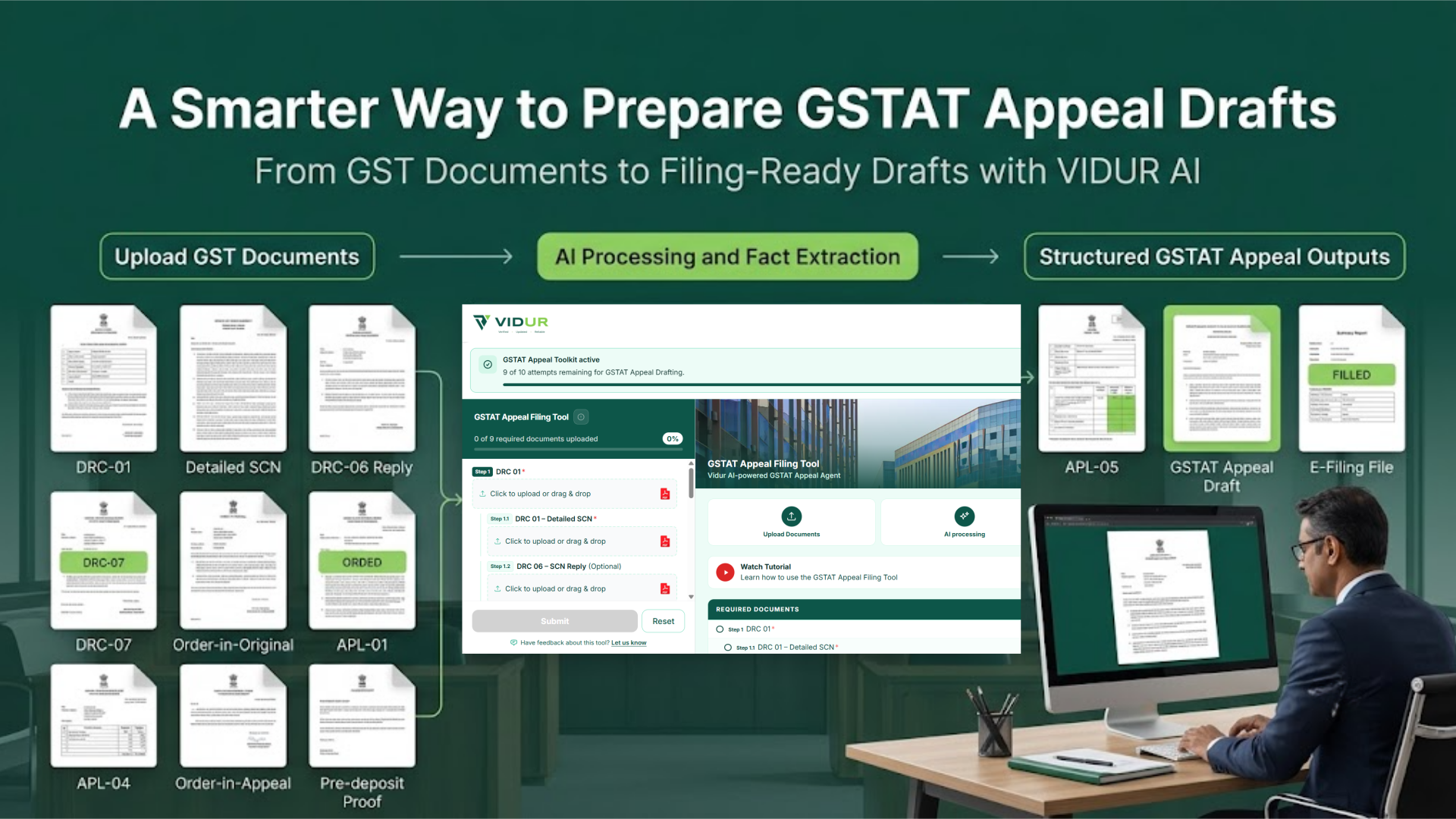
VIDUR AI GSTAT Appeal Filing Tool is an AI-powered GST appeal preparation tool built for CAs, GST consultants and tax professionals.
The tool helps users upload relevant GST appeal documents, processes them through AI and generates structured output files that can be used for professional review and filing preparation.
The purpose of the tool is simple: to reduce repetitive drafting and document extraction work, so professionals can focus on legal review, strategy and finalisation.
How VIDUR AI GSTAT Appeal Filing Tool Works
The workflow is designed to be simple and practical.
Step 1: Open the GSTAT Appeal Filing Tool
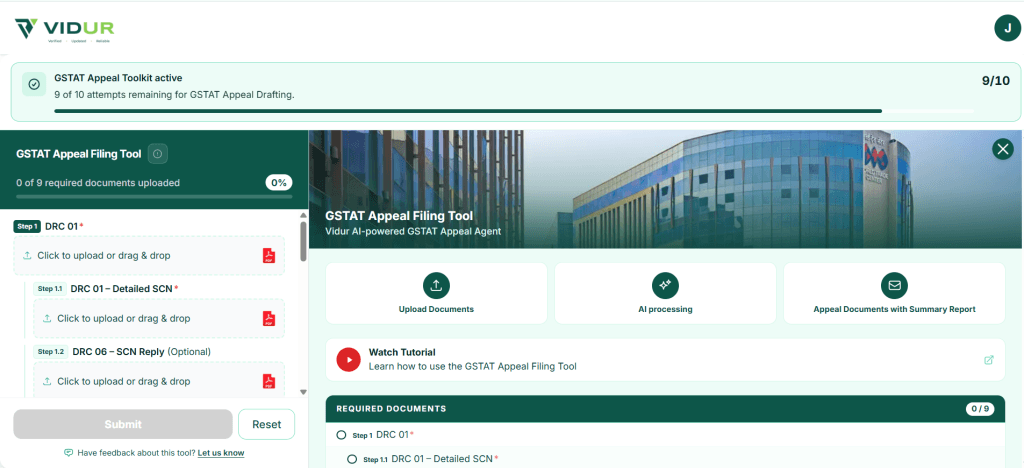
First, go to the VIDUR AI GSTAT Appeal Filing Tool from the VIDUR AI platform.
The tool opens with a clean document upload interface where the user can see the required documents and upload them step by step.
Step 2: Upload the Required Documents
The tool asks users to upload the main documents required for preparing a GSTAT appeal.
These include DRC-01, detailed SCN, DRC-06 reply, DRC-07, detailed Order-in-Original, APL-01, first appeal set, APL-02, GST APL-04, Order-in-Appeal, pre-deposit details and other supporting documents.
Users can also upload additional notes, draft grounds, internal working papers or any other material that may help in preparing the appeal.
This structured upload process helps ensure that important documents are not missed.
Step 3: Click Submit
Once the documents are uploaded, the user has to click on Submit.
After submission, VIDUR AI starts processing the uploaded documents.
Step 4: AI Processes the Appeal Documents
VIDUR AI analyses the uploaded files and extracts important details such as taxpayer information, order details, issue in dispute, demand details, appeal references, pre-deposit information, facts and possible grounds.
This helps create a base draft that the professional can review and refine.
Step 5: Receive Output on Email
After processing, the output is sent to the user’s email.
The output may include:
- Filled APL-05
- GSTAT Appeal Draft
- Filled E-Filing File
In practice, this helps professionals move from document upload to first-level appeal preparation much faster.
What Output Does VIDUR AI Generate?
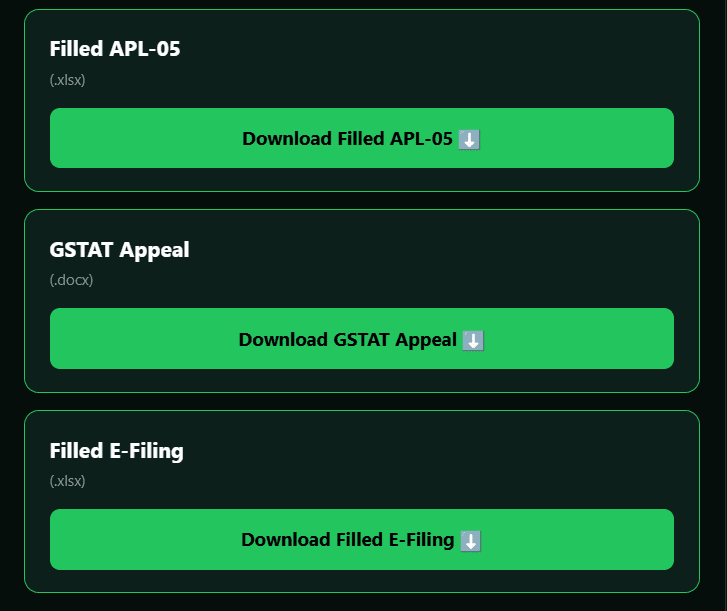
The VIDUR GSTAT Appeal Filing Tool gives output in formats that are useful for real GST litigation work.
1. Filled APL-05
APL-05 is the form used for taxpayer appeals before GSTAT. VIDUR AI helps prepare a filled APL-05 file based on the documents uploaded by the user.
2. GSTAT Appeal Draft
The tool generates a structured appeal draft in Word format. This may include the background of the case, facts, issues, grounds of appeal and relief sought.
3. Filled E-Filing File
VIDUR AI also generates an e-filing support file to help organise details required for GSTAT portal filing.
Why Use AI for GSTAT Appeal Filing?
AI is most useful where the work involves reading large documents, extracting important information and preparing structured drafts.
GSTAT appeal preparation involves exactly that.
VIDUR AI helps reduce the manual effort involved in:
- Reading long GST orders
- Extracting relevant facts
- Identifying issue-wise dispute points
- Preparing structured appeal drafts
- Filling appeal-related details
- Creating a summary for quick review
This does not mean that AI replaces the professional. It means AI gives the professional a stronger starting point.
The final review, editing, legal arguments and filing decision should always remain with the CA, advocate or authorised representative.
Who Can Use VIDUR AI GSTAT Appeal Filing Tool?
The tool is useful for professionals and teams dealing with GST litigation, including:
- Chartered Accountants
- GST consultants
- Tax advocates
- CA firms
- Indirect tax teams
- Corporate tax departments
- Litigation support teams
For firms handling multiple GST appeal matters, the tool can also help bring more consistency to the appeal preparation process.
Manual GSTAT Drafting vs VIDUR AI GSTAT Appeal Tool
| Particulars | Manual Preparation | VIDUR AI GSTAT Tool |
|---|---|---|
| Document review | Fully manual | AI-assisted |
| Fact extraction | Manual reading and notes | Extracted from uploaded documents |
| Appeal draft | Prepared from scratch | Structured draft generated |
| APL-05 details | Manually filled | Filled output prepared |
| Summary | Manually prepared | Summary report generated |
| Time involved | High | Reduced |
| Professional review | Required | Required |
The key benefit is not that AI does everything. The key benefit is that AI helps reduce the first-draft burden.
Best Practices Before Using the Tool
To get better results from VIDUR AI GSTAT Appeal Filing Tool, users should keep the documents clean, complete and properly scanned.
Professionals should also upload all major documents in the dispute chain, especially the SCN, reply, Order-in-Original, first appeal papers and Order-in-Appeal.
If the professional already has draft grounds or client notes, those should also be uploaded. This helps the tool understand the matter better and prepare a more relevant output.
After receiving the output, users should carefully verify:
- GSTIN and taxpayer details
- Order numbers and dates
- Demand amount
- Disputed amount
- Pre-deposit details
- Facts and chronology
- Grounds of appeal
- Relief claimed
- Annexure references
AI can speed up preparation, but final accuracy must always be checked by the professional.
Does VIDUR AI File the Appeal Automatically?
No.
VIDUR AI helps in preparing GSTAT appeal documents. The actual filing on the GSTAT portal should be completed by the taxpayer or authorised professional after reviewing the generated output.
This distinction is important because appeal filing involves statutory responsibility, professional judgment and case-specific legal strategy.
VIDUR AI is a drafting and preparation assistant, not a replacement for professional review.
Why This Matters for CAs and GST Professionals
GSTAT appeals are likely to become a regular part of GST litigation practice. As more matters move to the Tribunal stage, professionals will need faster and more organised ways to handle appeal preparation.
Manual drafting will continue to require time, especially where the file contains multiple notices, replies, orders and supporting documents.
With VIDUR AI GSTAT Appeal Filing Tool, professionals can reduce repetitive work and spend more time on what matters most: reviewing the case, improving grounds, strengthening legal arguments and advising clients better.
Conclusion
GSTAT Appeal Filing Using AI is not about replacing professionals. It is about making the appeal preparation process faster, cleaner and more structured.
VIDUR AI GSTAT Appeal Filing Tool allows users to upload relevant GST documents, submit them for AI processing and receive useful outputs such as Filled APL-05, GSTAT Appeal Draft, Filled E-Filing File and Summary Report.
For CAs, advocates and GST consultants, this can save significant preparation time and improve workflow efficiency.
As GST litigation becomes more digital and document-driven, AI tools like VIDUR can help professionals stay faster, better organised and more prepared.