

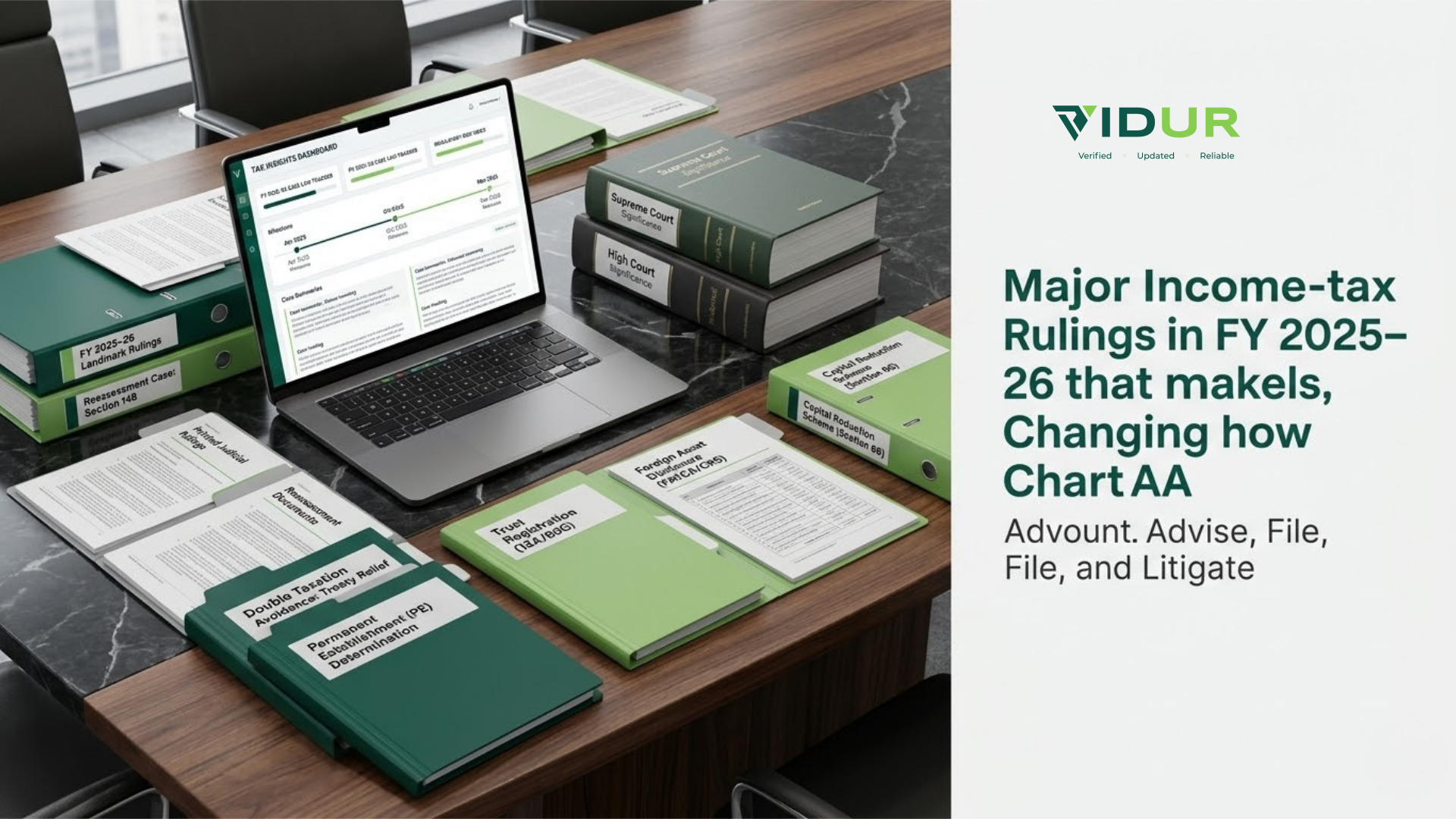
A client asks a CA, “Which judgments from this year actually change how we advise, file, and litigate?” That is the right test. FY 2025–26 has already produced rulings that materially affect international tax, capital transactions, trusts, foreign-asset reporting, treaty benefits, and day-to-day computational issues.
Following are the 10 IT rulings of legal significance and practical impact.
1. The Authority for Advance Rulings (Income Tax) v. Tiger Global International II Holdings — 2026 INSC 60 / 2026 SCC OnLine SC 86
The Supreme Court denied treaty relief on the Flipkart exit and upheld rejection of the advance ruling request on the basis that the arrangement was, at least prima facie, designed for tax avoidance. For CAs, the importance goes beyond one transaction. The ruling weakens any assumption that a Mauritius tax residency certificate by itself is enough where control, commercial substance, and the overall structuring story point elsewhere.
2. Hyatt International Southwest Asia Ltd. v. Additional Director of Income-tax — (2025) 478 ITR 238 (SC)
The Supreme Court held that Hyatt’s role in hotel operations, staffing, branding, pricing, and bank-account management went far beyond advisory or consultancy support and created a fixed place permanent establishment in India. This is one of the year’s most important international-tax rulings because it forces a fresh review of cross-border management agreements that are documented as advisory but operate as control arrangements in substance.
3. Director of Income-tax (IT)-I, Mumbai v. American Express Bank Ltd. — 2025 INSC 1431 / 2025 SCC OnLine SC 2806
The Court held that section 44C applies even where the relevant head-office expenditure is incurred exclusively for Indian branches and is not merely a common overhead allocation. For foreign banks and branch structures, this significantly narrows the room to argue that India-specific head-office costs escape the statutory cap. For CAs, it is a direct computation and provisioning ruling rather than just an academic international-tax point.
4. Union of India & Ors. v. Rajeev Bansal — 2024 INSC 754 / (2024) 469 ITR 46 (SC)
The Supreme Court settled the long-running reassessment controversy arising from the shift to the post-Finance Act 2021 regime and the TOLA extensions. It held that reassessment notices issued after 1 April 2021 had to be tested under the new limitation framework, while also laying down how the surviving limitation period would be computed after Ashish Agarwal. For CAs, this became one of the year’s most important procedural rulings because it directly affects the validity of reopening notices, the cut-off for AY 2013-14 to AY 2015-16 cases, and the strategy for challenging or defending reassessment proceedings.
5. Principal Commissioner of Income Tax-4 v. Jupiter Capital (P.) Ltd. — 2025 INSC 38
The Supreme Court held that reduction of share capital resulting in extinguishment of shareholder rights amounts to a transfer under section 2(47). For corporate groups and restructuring advisors, this confirms that capital reduction cannot be treated as a purely corporate-law event. It can trigger real capital gains or capital loss consequences in shareholder hands and therefore needs tax modelling from the start.
6. Equity Intelligence AIF Trust v. Central Board of Direct Taxes & Anr. — 2025:DHC:6170-DB
The Delhi High Court held that a Category III AIF could not be forced into maximum marginal rate treatment merely because investor names were not written into the original trust deed, particularly when regulatory requirements made that impracticable. For fund advisors and CAs working on trust structures, this is a landmark ruling because it aligns tax analysis with commercial and SEBI-regulated reality rather than insisting on an artificial deed format.
7. Vinil Venugopal v. DDIT (Inv.) — [2025] 179 taxmann.com 618 (Mum. – Trib.)
The ITAT Special Bench held that penalty for non-disclosure of foreign assets in Schedule FA under the Black Money Act is not automatic and that the use of the word “may” in section 43 indicates discretion. For practitioners, this is one of the most useful compliance rulings of the year because foreign-asset reporting lapses often arise from omission, misunderstanding, or poor control systems rather than deliberate concealment.
8. Sky High Appeal XLIII Leasing Company Ltd. v. Assistant Commissioner of Income-tax (International Tax) — [2025] 177 taxmann.com 579 (Mumbai – Trib.)
The Mumbai Tribunal held that the Principal Purpose Test under the MLI cannot be used to deny treaty benefits without a specific section 90(1) notification bringing the treaty modification into force domestically. The Tribunal also rejected the Revenue’s permanent-establishment theory on aircraft dry leases. For cross-border tax practice, this ruling is important because it links treaty anti-abuse enforcement to the mechanics of Indian domestic implementation, not just to broad anti-avoidance assertions.
9. Jayshreeben Jayantibhai Palsana v. Income-tax Officer — [2025] 177 taxmann.com 411 (Ahmedabad – Trib.)
The Ahmedabad Tribunal held that, under the law as it stood for the relevant period, rebate under section 87A could not be denied merely because the tax arose on short-term capital gains under section 111A. This became one of the most practical taxpayer rulings of the year because automated denials had affected a large number of smaller return filers. For CAs, it also showed how tribunal decisions can remain operationally relevant even where the legislature later moves prospectively.
10. Ramtirth Godavari Seva Samiti v. CIT (Exemptions) — [2026] 182 taxmann.com 950 (ITAT Pune)
The Pune Tribunal held that delay in filing Form 10AB, coupled with an incorrect clause selection, should not automatically defeat a charitable institution’s claim for registration under section 12AB where the lapse is bona fide and capable of rectification. The matter was remanded for fresh consideration after giving the assessee an opportunity to cure the defect. For CAs advising trusts and non-profits, this is a practical ruling on how procedural mistakes in the new registration regime should be handled.
Key Themes Emerging From FY 2025–26 So Far
Taken together, these rulings show four clear themes in FY 2025–26 so far: substance-over-form in international tax, tighter scrutiny of structure-based claims, useful relief in selected compliance disputes, and sharper computational clarity in trusts and capital transactions. That is why these cases matter beyond the courtroom. They directly affect opinions, return positions, appellate strategy, and client communication for CAs.