


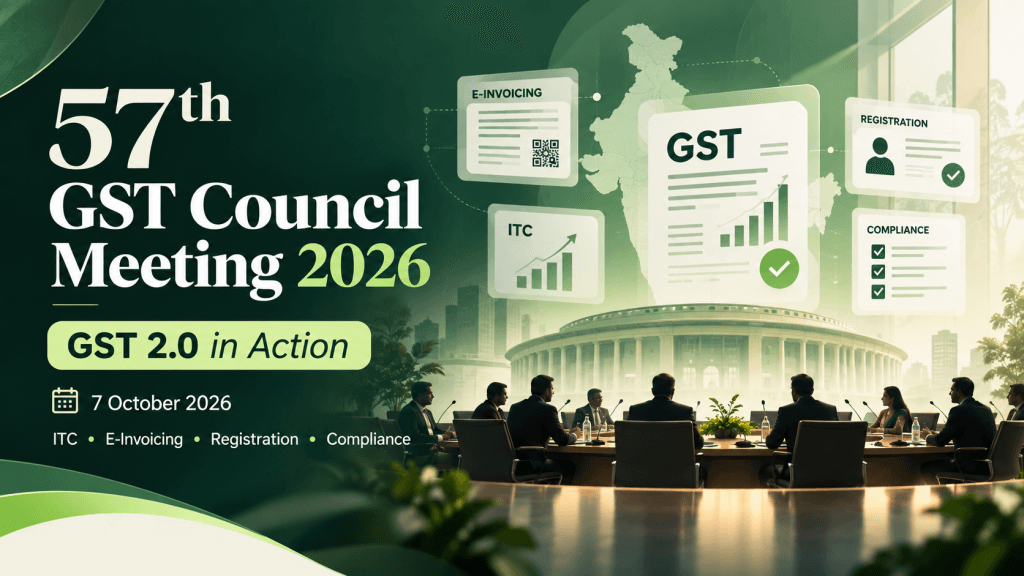
The 57th GST Council meeting, scheduled for 7 October 2026 in New Delhi, is expected to focus primarily on process reforms under the “GST 2.0” framework—covering e-invoicing, input tax credit (ITC) rules, registration simplification, and compliance automation—while keeping broad-based tax rate changes off the table.
This makes it a crucial session for Chartered Accountants, tax practitioners, and businesses, as the decisions could directly impact day-to-day compliance, cash flow, and litigation risk.
Meeting Details and Context
- Date: Wednesday, 7 October 2026
- Venue: New Delhi
- Chairperson: Union Finance Minister Smt. Nirmala Sitharaman
- Officers’ Meeting: 5–6 October 2026 (preparatory discussions by tax officials)
- Reported reason for rescheduling: Originally planned for 12 September 2026, the meeting was postponed amid a scheduling clash with the BRICS Leaders’ Summit in New Delhi.
This is the first Council meeting after the major rate rationalisation exercise at the 56th GST Council Meeting in September 2025, which consolidated GST into a simplified two-rate structure of 5% and 18%, along with a special 40% rate for select luxury and demerit goods.
With rates largely settled, the October meeting is expected to shift attention to how GST works in practice—the pain points businesses and practitioners face every day.
Key Agenda Items: What’s Likely to Be Discussed
While the formal agenda has not yet been officially published, multiple reports and statements indicate that the following areas may receive significant attention.
1. Input Tax Credit (ITC) Reforms
ITC disputes are among the biggest sources of litigation and compliance stress for businesses. The Council is expected to examine:
- Credit where the supplier defaults: Currently, Section 16(2)(c) of the CGST Act denies ITC to the buyer if the supplier has not paid the tax to the government, even if the buyer has paid the full invoice value. A proposal under consideration is to provide relief to genuine recipients where payment and the underlying transaction can be adequately established.
- Blocked ITC categories: Possible relaxation of restrictions on certain ITC claims, including specified employee-related benefits and other expenses presently covered by blocked credit provisions.
- Accumulated credits under inverted duty structure: The Council may consider simplifying the refund application process and removing operational hurdles that delay the disbursement of unutilised credit under the inverted duty structure. This could ease liquidity constraints for manufacturing sectors affected by higher tax rates on inputs than on outputs.
Why it matters: Any change here can significantly improve working capital for businesses and reduce the volume of GST disputes, show-cause notices and appeals. However, changes to ITC conditions embedded in the CGST Act may require legislative amendment and are unlikely to become effective merely through a Council recommendation.
2. E-Invoicing and Return Matching
E-invoicing and ITC rules are expected to be important parts of the meeting’s process-reform discussions.
Likely discussion points include:
- Extending e-invoicing: The Council may examine expansion of e-invoicing requirements to additional categories of taxpayers. For smaller businesses, any expansion would require compliant billing software, real-time IRN generation capability, and adequate transition time.
- Improving invoice matching: Better matching between GSTR-1 and recipient-side ITC records could help reduce mismatches that delay or block credit. Small businesses often face cash flow strains because of vendor reporting errors, timing differences, or reconciliation issues.
- Simplifying compliance: Small taxpayers continue to face challenges from frequent portal changes, technical issues, and compliance costs. A more automated framework could be accompanied by smoother transition periods and clearer grievance-redressal mechanisms.
Why it matters: Better matching and wider use of e-invoicing can reduce fraud and improve compliance, but smaller businesses may require adequate guidance, technology support, and transition time to avoid disruption.
3. GST Registration Simplification
Registration delays and inconsistent administrative practices across jurisdictions remain a major grievance, particularly for businesses looking to commence or expand operations.
Reported proposals include:
- Simplified procedure for larger applicants: A simplified registration mechanism already exists for certain low-risk applicants whose monthly output tax liability does not exceed ₹2.5 lakh. The reported discussions now include creating a more uniform and streamlined process for larger applicants, including businesses crossing the ₹2.5 lakh threshold, where practices may currently differ across central and state GST formations.
- Automation of registration cancellation and suspension: Introducing more system-driven processing for voluntary registration cancellations and related procedures could reduce manual intervention, officer discretion, and administrative delays for non-operational or restructured businesses. Courts have also repeatedly examined procedural safeguards in cases involving cancellation of GST registration.
- Multi-state registration for small businesses: A simplified mechanism for eligible small businesses and e-commerce suppliers operating across multiple states may also be considered. Such a framework could reduce the administrative burden of maintaining separate registrations and compliance processes across jurisdictions.
- Faceless administration: Expanding technology-driven and faceless GST administration to selected assessments, registrations, or other processes could improve transparency, minimise subjectivity, and promote greater consistency in decision-making.
Why it matters: Faster, transparent, and more predictable registration directly affects a business’s ability to start operations, issue invoices, and claim ITC without unnecessary delays. Changes involving rules, circulars, and administrative procedures may also be capable of faster implementation than amendments requiring changes to the CGST Act.
What Is Not Expected: Major Rate Changes
The meeting is expected to focus primarily on process reforms, rather than another broad-based overhaul of GST rates.
- The Council may review how the rate rationalisation introduced after the 56th meeting is functioning in practice.
- Product-specific representations or proposals may still come up for discussion, but another major restructuring of GST slabs is not presently expected.
For businesses hoping for rate relief, the key distinction is that this meeting is expected to focus more on how GST is administered than on how much GST is charged.
Practical Implications for CAs and Businesses
For Chartered Accountants and Tax Practitioners
- Advisory opportunity: Use the meeting as an opportunity to review client processes around ITC documentation, e-invoicing readiness, vendor reconciliation, and registration status.
- Litigation strategy: For clients facing ITC demands under Section 16(2)(c), maintain robust supporting documentation including invoices, e-way bills, GSTR-2B extracts, proof of receipt of goods or services, and banking proof of payment including tax.
- Technology readiness: Businesses that may eventually come within an expanded e-invoicing framework should review whether their accounting and billing systems are capable of integrating with GST compliance requirements.
- Registration review: Businesses expanding into new states or restructuring existing registrations should continue following the current legal framework until any proposed simplification is formally notified.
What to Watch After 7 October
Once the meeting concludes, watch for:
- Official recommendations or press release from the GST Council Secretariat and the Government.
- CBIC notifications implementing changes to the CGST Rules, procedures, rates, or exemptions, wherever required.
- Legislative amendments, where a proposed reform requires changes to the CGST Act.
- State notifications implementing corresponding SGST changes, where applicable.
- Circulars and instructions clarifying implementation details relating to ITC, e-invoicing, registration, refunds, and other procedural reforms.
For CAs and businesses, the key is to wait for the official notification or legislative change before altering a tax position or claiming a new benefit.
A GST Council recommendation by itself does not ordinarily change a taxpayer’s legal obligation until the relevant legislative, notification, rule, circular, or other implementation mechanism takes effect.
Final Take
The 57th GST Council meeting on 7 October 2026 is expected to be less about headline rate changes and more about ground-level GST reform—simpler registration, clearer ITC rules, better technology-led compliance, improved invoice matching, and reduced procedural friction.
For Chartered Accountants and tax practitioners, the meeting will be important not only for understanding new GST rules but also for helping businesses prepare for the operational realities of GST 2.0.
The most important step after the meeting will be to distinguish between Council recommendations and legally effective changes and to track the notifications, circulars, rules, and amendments that follow.