


“Our investors love seeing our Earnings Before Interest, Taxes, Depreciation, and Amortization (EBITDA) figures in presentations, but I hear the rules around these non-GAAP measures are getting stricter,” a CFO mentioned to her CA during a planning meeting. “And what’s this about a mandatory ‘Operating Profit’ subtotal?”
The CA nodded. “You’re right. A wave of significant changes is coming to financial reporting, driven by new International Financial Reporting Standards (IFRS). The goal is greater transparency and comparability. We’ll need to rethink not just how we present our performance measures, but the very structure of our profit and loss statement.”
Financial reporting is on the verge of a major evolution. Driven by investor demand for clarity and consistency, the International Accounting Standards Board (IASB) has introduced several new standards and amendments. For tax professionals in India, staying ahead of these changes, which are set to be adopted as new Ind AS, is critical. Here are three of the most significant shifts you need to know about.
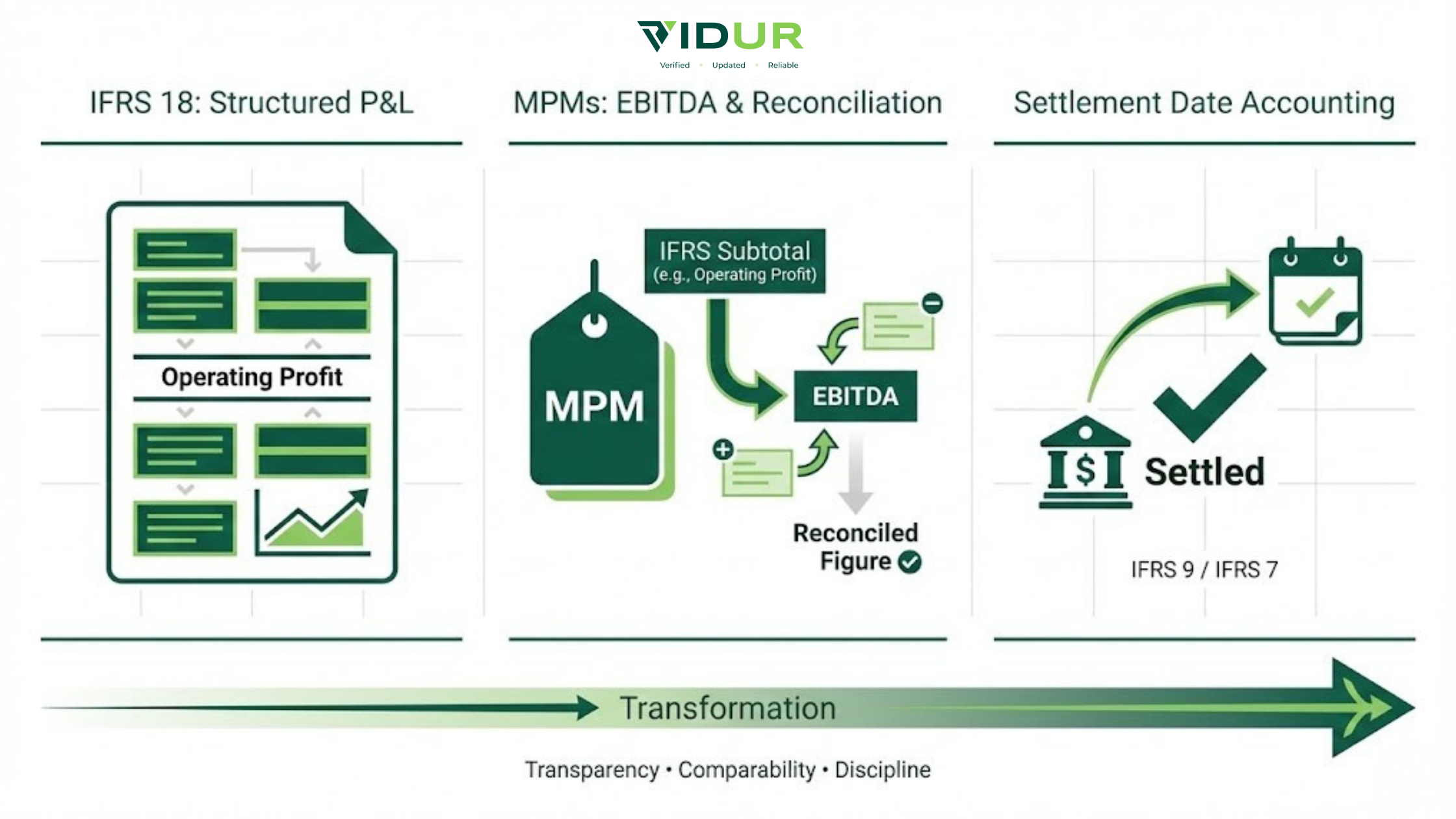
1. A New, Structured Profit & Loss Statement (IFRS 18)
The most impactful change comes from IFRS-18, which will replace the current IAS-1 for presentation of financial statements. The new standard aims to end the creative and often inconsistent ways companies present their performance. It mandates a more rigid structure for the Statement of Profit or Loss, introducing defined categories and subtotals to improve comparability.
Key changes include:
- Defined Categories: The P&L will now be structured into five distinct categories: Operating, Investing, Financing, Income Taxes, and Discontinued Operations.
- Mandatory Subtotals: All companies will be required to report a consistently defined ‘Operating profit’ and ‘Profit before financing and income taxes’. This provides a uniform starting point for analysis, a stark contrast to the many different definitions of “operating profit” currently in use.
New P&L Categories
| Category | What it Includes |
|---|---|
| Operating | Income and expenses from a company’s main business activities. |
| Investing | Income and expenses from investments not part of the main business (e.g., returns on financial assets, income from investment property). |
| Financing | Costs associated with raising capital (e.g., interest on loans and leases). |
This structured approach will bring much-needed discipline and make it easier for investors to compare the core performance of different companies.
2. Taming the ‘Non-GAAP’ Measures (MPMs)
IFRS-18 also introduces strict new rules for what it calls Management-defined Performance Measures (MPMs)—more commonly known as non-GAAP or alternative measures like EBITDA. While acknowledging their usefulness, the standard aims to increase transparency and prevent misleading presentations.
Under the new rules, if a company presents an MPM in its public communications (like investor presentations), it must:
- Provide Reconciliation: Disclose a detailed reconciliation in a single note, showing how the MPM is calculated from the most comparable IFRS-defined subtotal.
- Explain its Relevance: Describe why management believes the measure is useful and how it provides their view of performance.
- State Non-Comparability: Include a statement clarifying that the measure is not necessarily comparable to similarly labeled measures from other companies.
This will force companies to be more disciplined and transparent about the popular metrics they use to supplement their statutory financial statements.
3. Clarifying the ‘When’: Settlement Date Accounting
Recent amendments to IFRS-9 and IFRS-7 address a long-standing point of diversity in practice: when to account for the settlement of financial assets and liabilities. The new guidance clarifies that ‘settlement date accounting’ is the rule.
In simple terms, both the entity paying and the entity receiving cash should account for the transaction on the date the cash is actually settled (i.e., received or paid), not the date the payment was initiated.
For example, if a customer initiates an electronic payment on March 30th, but the cash arrives in the seller’s bank account on April 1st, both parties will recognize the transaction on April 1st. This change will primarily impact non-instantaneous cross-border payments or payments by cheque, eliminating the ambiguity of ‘cash in transit’ over a reporting period end.
Preparing for a More Transparent Future
These upcoming changes signal a clear global trend towards greater transparency, comparability, and discipline in financial reporting. As India aligns its standards with these global benchmarks, tax professionals must prepare their clients for a new era of clarity. The focus is shifting from mere compliance to effective communication, ensuring that financial statements provide a true and fair view in an increasingly complex world.
Ready to navigate the complexities of modern legal and financial compliance with confidence? Discover how Vidur AI can empower your practice with intelligent, AI-driven insights.