


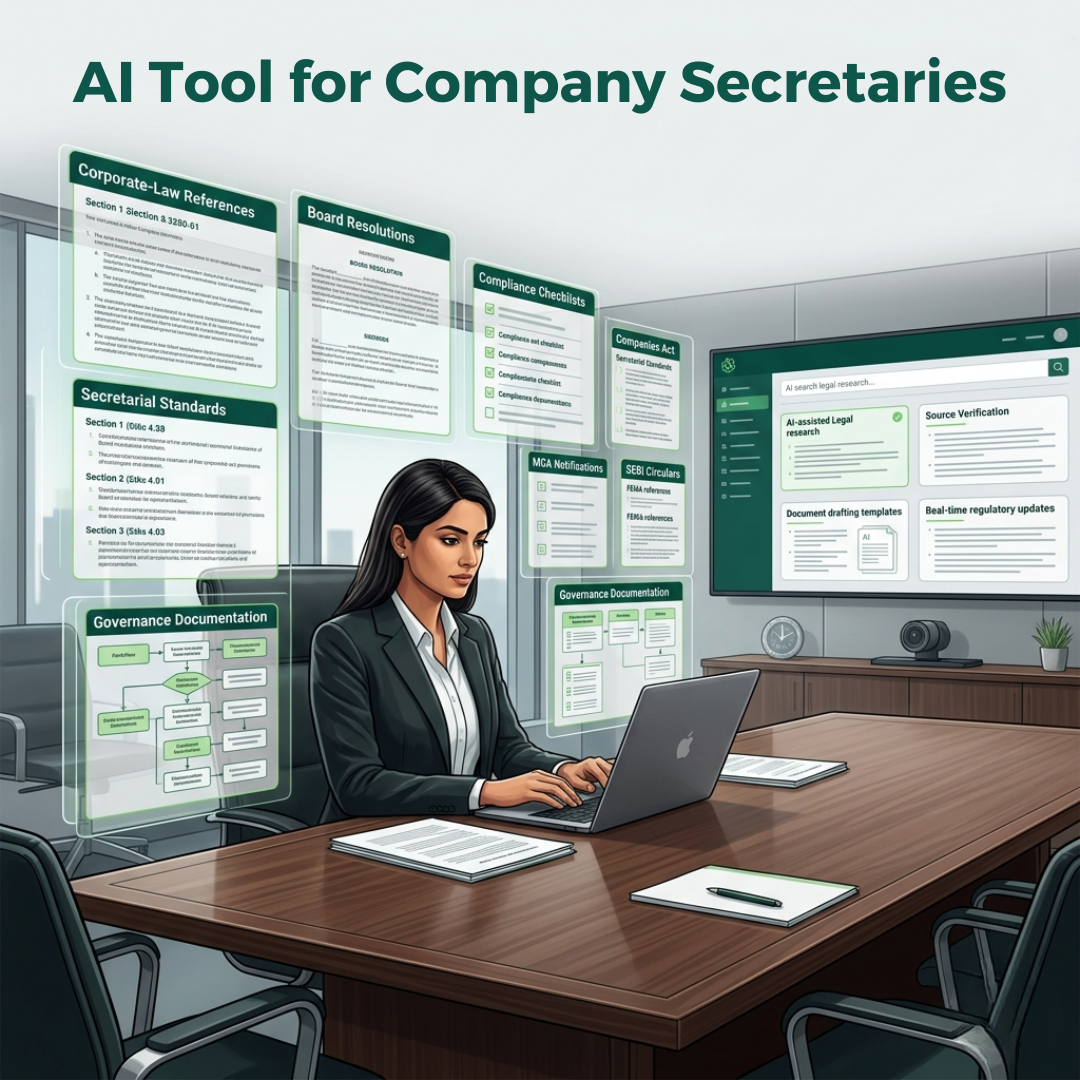
A Company Secretary does far more than “know company law”. The role demands careful reading of the Companies Act, related rules and regulations, disciplined drafting, accurate board documentation, practical interpretation of Secretarial Standards, and constant attention to what MCA, SEBI and RBI are changing next. That is why the real question in 2026 is not whether AI can produce text. It is whether AI can produce traceable, reviewable, professional-grade work that actually helps a CS move faster without cutting corners.
On that standard, VIDUR AI stands out as one of the best AI tools for Company Secretaries in India. Publicly, it is positioned not as a generic chatbot, but as an AI assistant for tax, corporate and regulatory research and drafting, with verifiable source links and workflows designed around professional outputs such as research notes, updates, advisories and drafts.
Why Company Secretaries need AI now
The modern CS sits at the junction of governance, documentation and fast-changing regulation. On the governance side, Section 118 directly addresses minutes of proceedings and resolutions, while the revised SS-1 and SS-2, effective from 1 April 2024, remain central to how board meetings and general meetings are documented. These are not casual drafting exercises. They are high-consequence records where wording, structure and legal footing matter.
The update burden is just as real. MCA’s own year-end review for 2025 says the Ministry reviewed and notified a series of amendments under the Companies Act and issued general circulars around the MCA V3 transition, timelines and meeting formats.
SEBI’s master-circular page shows continuing updates through 2025 and 2026 across LODR, ICDR, registrars, research analysts, investment advisers, mutual funds, surveillance, InvITs and REITs.
RBI’s foreign exchange management pages and FAQs were also updated in 2026, including material on INR trade settlement, FLA reporting, ECBs and related FEMA topics. For a CS, that means the research problem is continuous, not one-off.
This is where AI becomes genuinely useful. A CS does not need software that claims to “do compliance” on its own. What a CS actually needs is help with finding the right section or circular quickly, producing a well-structured first draft, surfacing source links, comparing documents, and keeping up with regulatory updates without reading every notification from scratch.
What makes VIDUR AI different
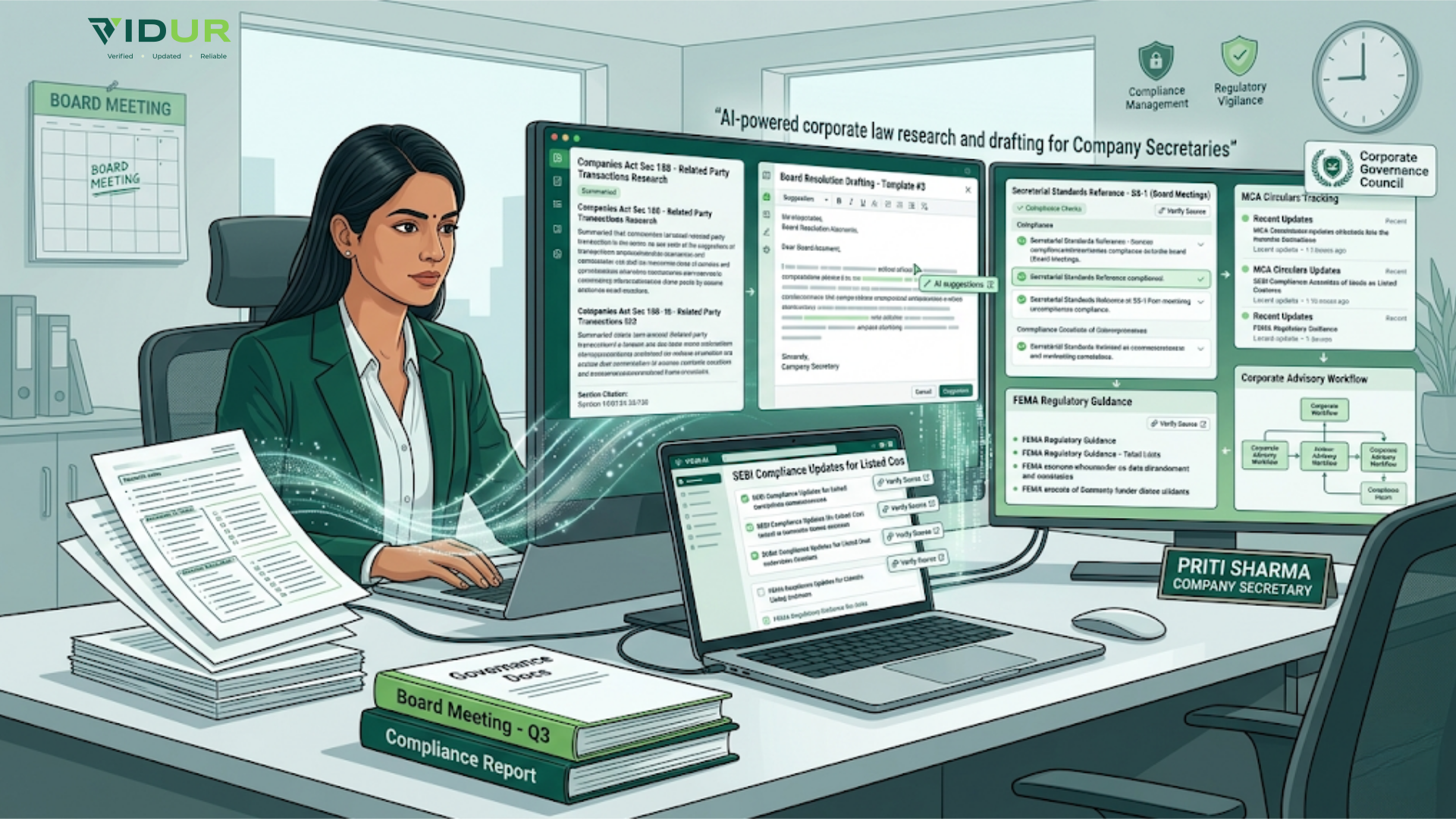
VIDUR’s public positioning is unusually specific. The homepage says it is built by ex-Big 4 and Tier 1 law-firm professionals, that it provides up-to-date knowledge, and that it covers areas including Companies Act, FEMA, SEBI, insolvency, direct and indirect taxes, accounting standards and audit. Just as importantly, it says answers come with 100% verifiable reference links, and that those references are clickable and downloadable. In a CS workflow, that matters more than flashy prose. It means the AI output can become a starting point for a real professional note rather than an isolated paragraph that no one can substantiate.
VIDUR also exposes workflow controls that map neatly to professional practice. The Law Type button lets users select the relevant laws, while Choose Style tailors the output to House Style, Research, Update, Advisory or Drafting. Users can upload documents and ask VIDUR to analyse them through the lens of the selected law type and output style. That is more useful for a CS than a single generic prompt box, because the same matter often needs multiple passes: first research, then an internal note, then a board paper, then a cleaner client-facing draft.
Another strength is the update layer. VIDUR is updated in real time with case law, notifications, circulars and analytical insights; the “VIDUR Insights” description calls these live updates by VIDUR experts; and the public updates page shows searchable daily tax and corporate updates, including corporate-law and banking/finance items relevant to MCA, SEBI and FEMA themes. Vidur’s daily updates are curated by in-house lawyers and CAs. That is close to what a busy CS actually wants: not just a database, but a way to cut through change faster.
VIDUR AI features for Company Secretary Workflows
For Companies Act research, VIDUR has the right public signals. Its homepage places Companies Act within its core coverage, and its corporate sources visibly include company-meeting materials. If your recurring work involves questions around meetings, board powers, KMPs, related party questions, restructuring, or interpretation of corporate-law provisions, VIDUR’s public design is much closer to a CS workflow than a general model trained on mixed internet text.
For board resolutions and notices, the public marketing is even clearer. VIDUR says users can draft tax and corporate notices, resolutions and submissions in minutes, and its demo page explicitly mentions board resolutions among the drafting outputs. For a Company Secretary, that creates a strong use case for generating a first draft of a board resolution, explanatory note or meeting notice that is then checked against the applicable section, rules, Secretarial Standards and company-specific facts before circulation.
For minutes, the public materials do not show a dedicated “minutes module”, so this needs to be stated honestly. However, because VIDUR supports corporate-law drafting, document upload, source-backed responses and company-meeting source material, it is a reasonable first-draft tool for minutes—especially for turning agenda notes and meeting outcomes into a structured initial draft that can then be legal-reviewed against Section 118 and SS-1. In other words, VIDUR fits best as a drafting accelerator, not as an autonomous minute-book authority.
For legal citations and source verification, VIDUR is strongest on the public record. The platform repeatedly claims verifiable, clickable and downloadable source references, and its answer-features page shows that responses can be copied, downloaded as Word documents and shared by public link. For internal teams and client service, that matters because CS work often requires not just a conclusion, but a conclusion that can be tracked back to a section, commentary, case or circular.
For MCA, SEBI and FEMA update-tracking, public materials are favourable but should be described precisely. VIDUR clearly offers live updates, VIDUR Insights, and a public daily-updates hub. It also says WhatsApp is intended for quick and short responses, while the web and app are better for complete references.
Practical Use Case for Company Secretary
A CS in its practice could use VIDUR to convert a factual question—say, a board approval issue, director-related action, committee matter or corporate restructuring point—into a research note with applicable sections, rules, commentary-backed interpretation and a draft resolution. That directly aligns with VIDUR’s public “Research / Advisory / Drafting” styles and its verified-source model.
A CS advising listed entities or market intermediaries could use it as a cross-regulatory explainer where corporate law touches SEBI and FEMA. VIDUR’s own 2025 article describes cross-regulator synthesis for FEMA, RBI, SEBI, IBC and tax questions, which is valuable because many real-world secretarial matters do not stay inside one statute.
A CS team handling recurring documents could use VIDUR’s prompt library, answer download and share-link features to build reusable internal patterns for board notes, management briefs, issue summaries and update memos. VIDUR’s public pages describe a prompt library in the thousands, downloadable reports, shareable answer links and copy-ready outputs, all of which are practical for team standardisation.
A senior CS or team lead could also use VIDUR as a junior-enablement layer. The enterprise page talks about expert-led training, customisable workflows and organisation-specific repositories, while the core product repeatedly emphasises source-backed answers. That combination is useful where the goal is not merely to answer one question quickly, but to raise the quality of first drafts produced across the team.
Benefits
- Speed with Traceability: The biggest benefit is speed with traceability. VIDUR’s public feature set is designed to compress the time between “What is the legal position?” and “Can I send a reviewable draft?” without discarding references.
- Domain Fit: The second benefit is domain fit. VIDUR is not marketed as a general internet assistant. It does not search Google but relies on verified proprietary knowledge from experts and publishers.
- Workflow Flexibility: The third benefit is workflow flexibility. Web, mobile app and WhatsApp access, plus document upload, style controls, answer sharing and enterprise API/custom-workflow options, make the tool usable whether you are researching in the office, responding on the move or building an internal knowledge workflow for a larger team.
Final Verdict
If the phrase “Best AI Tool for Company Secretary” is meant in the practical Indian sense—best for Companies Act research, board-document drafting, source-backed answers, and staying on top of MCA/SEBI/FEMA movement—then VIDUR has a very strong public case. It is especially persuasive if your benchmark is not pure case-law depth alone, but the full day-to-day mix of research + drafting + advisory + updates that defines real CS work.