


“I understand the frustration,” the indirect tax lawyer explains to her client, the CEO of a national logistics firm. “You see fuel as your biggest input cost, yet you can’t claim any credit on the VAT you pay. It feels like a penalty for doing business.” She leans forward, adding, “This is the core of the petroleum debate in GST—a battle between eliminating cascading taxes and protecting state revenues. It’s one of the biggest hurdles we’re watching on the road to a truly unified tax system.”
India’s Goods and Services Tax (GST) was a monumental reform, replacing a dozen central and state levies with a single structure. The recent “GST 2.0” phase further simplified this by rationalizing rates and resolving classification disputes. Yet, the evolution is far from over. For tax professionals, the critical question now is: what lies beyond?
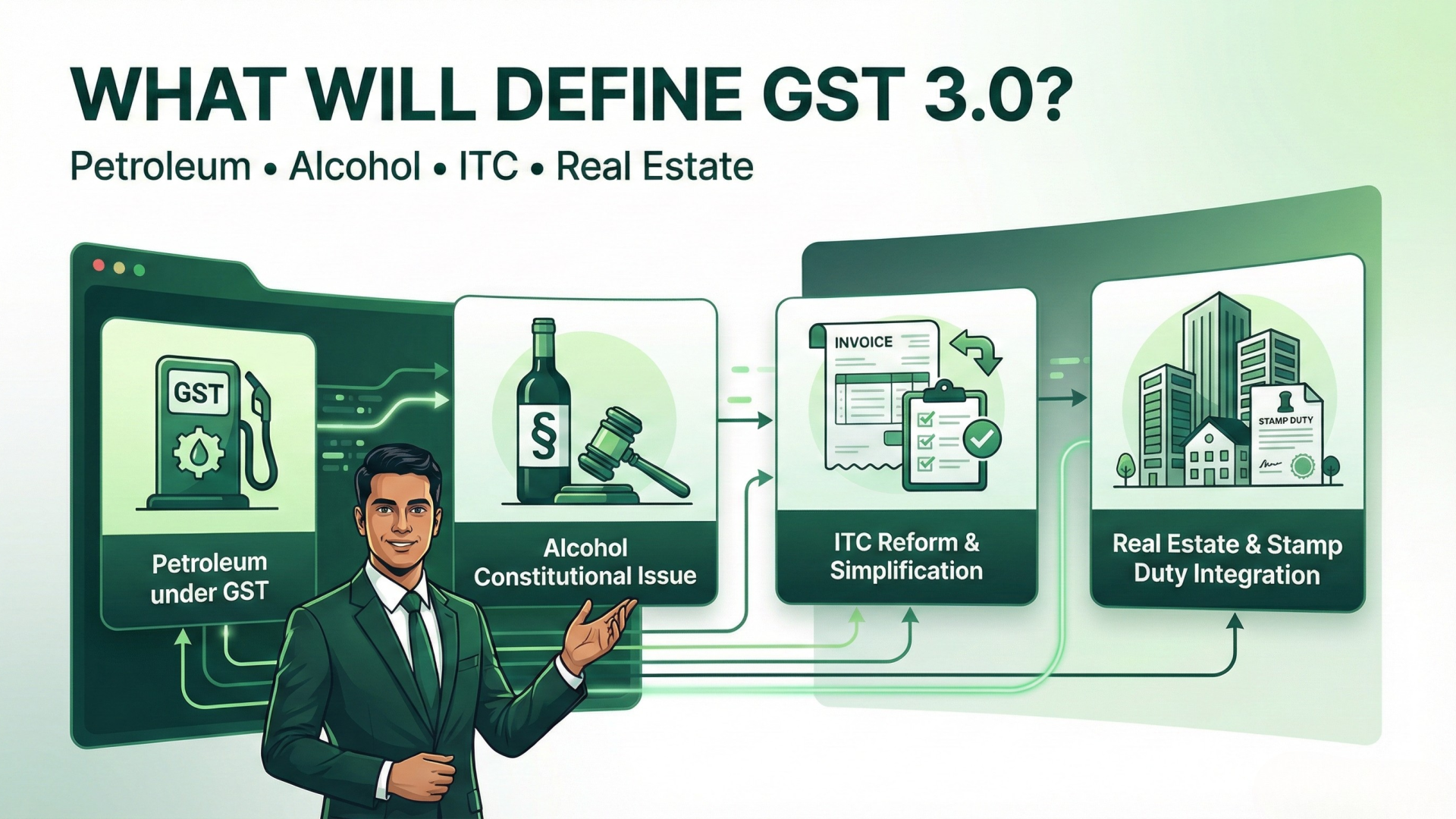
As we look toward a potential “GST 3.0,” several complex issues remain unresolved. Mastering these debates is essential for providing strategic advice in an ever-changing fiscal landscape. Here are four key frontiers every tax professional must watch.
1. The Petroleum Predicament: Fuelling the Cascading Tax Debate
The exclusion of petroleum products from GST is a major break in the anti-cascading chain. For industries like logistics and manufacturing, fuel is a primary input cost, and the inability to claim Input Tax Credit (ITC) on VAT inflates expenses. While including petroleum in GST would fix this, it poses a revenue challenge for the government. The solution requires a delicate balance: amending GST law for a higher fuel tax rate to protect revenues while extending ITC benefits to key sectors.
2. The Alcohol Impasse: A Constitutional Conundrum
While bringing petroleum into GST is a matter of political and fiscal will, including alcohol for human consumption is a far more complex constitutional issue. The power to tax alcohol is a significant source of independent revenue for states and is deeply entrenched in the Constitution. Unlike petroleum, which can be brought into GST via a recommendation from the GST Council, including alcohol would require a formal Constitutional Amendment Act. This process is fraught with political challenges, including the sensitive issue of state-level prohibition policies.
Petroleum vs Alcohol under GST – Simplified Comparison
Feature: Petroleum Products
Constitutional Barrier? No. Article 279A(5) allows the GST Council to recommend the inclusion date.
Path to Inclusion: A GST Council recommendation and subsequent notification.
Primary Challenge: Revenue neutrality—finding a GST rate high enough to match current Centre and State collections.
Feature: Alcoholic Liquor for Human Consumption
Constitutional Barrier? Yes. Article 366(12A) explicitly excludes it, requiring a Constitutional Amendment.
Path to Inclusion: A new Constitutional Amendment Act, followed by Council recommendations.
Primary Challenge: Political consensus—getting states to agree to give up a significant, autonomous revenue source.
3. The ITC Trust Deficit: Reforming the Heart of GST
A core frontier for GST 3.0 is rebuilding trust in the ITC mechanism. The current system’s focus on invoice-matching and supplier compliance creates a huge reconciliation burden. For CAs, this means hours spent on portal compliance and defending credits jeopardized by supplier errors. A future-forward GST should trust valid invoices for ITC claims, as in previous VAT/CENVAT regimes, freeing up professionals for strategic advisory. Navigating Section 16(2) and advocating for a fairer system is where tools like Vidur AI become indispensable, providing the legal research and case law analysis to champion your clients’ rights.
4. Expanding the Horizon: Real Estate and Beyond
The final frontier involves unifying India’s tax structure by subsuming levies like stamp duty into GST. This would bring the real estate sector fully into the GST ambit, representing the ultimate goal of “One Nation, One Tax.” For CAs, this potential shift necessitates a proactive approach—understanding the intricate legislative interplay and preparing for a paradigm shift in how property transactions are taxed.
Embrace the Future of Tax Advisory. Try Vidur AI.
Don’t just adapt to the digital age—lead it. Vidur AI is more than a tool; it’s your strategic partner in navigating the complexities of modern tax compliance. Empower your practice with AI-driven legal research, automated document analysis, and proactive compliance tools. Transform your workflow, mitigate risks, and deliver unparalleled value to your clients.
Ready to elevate your practice? Schedule your personalized demo of Vidur AI today!