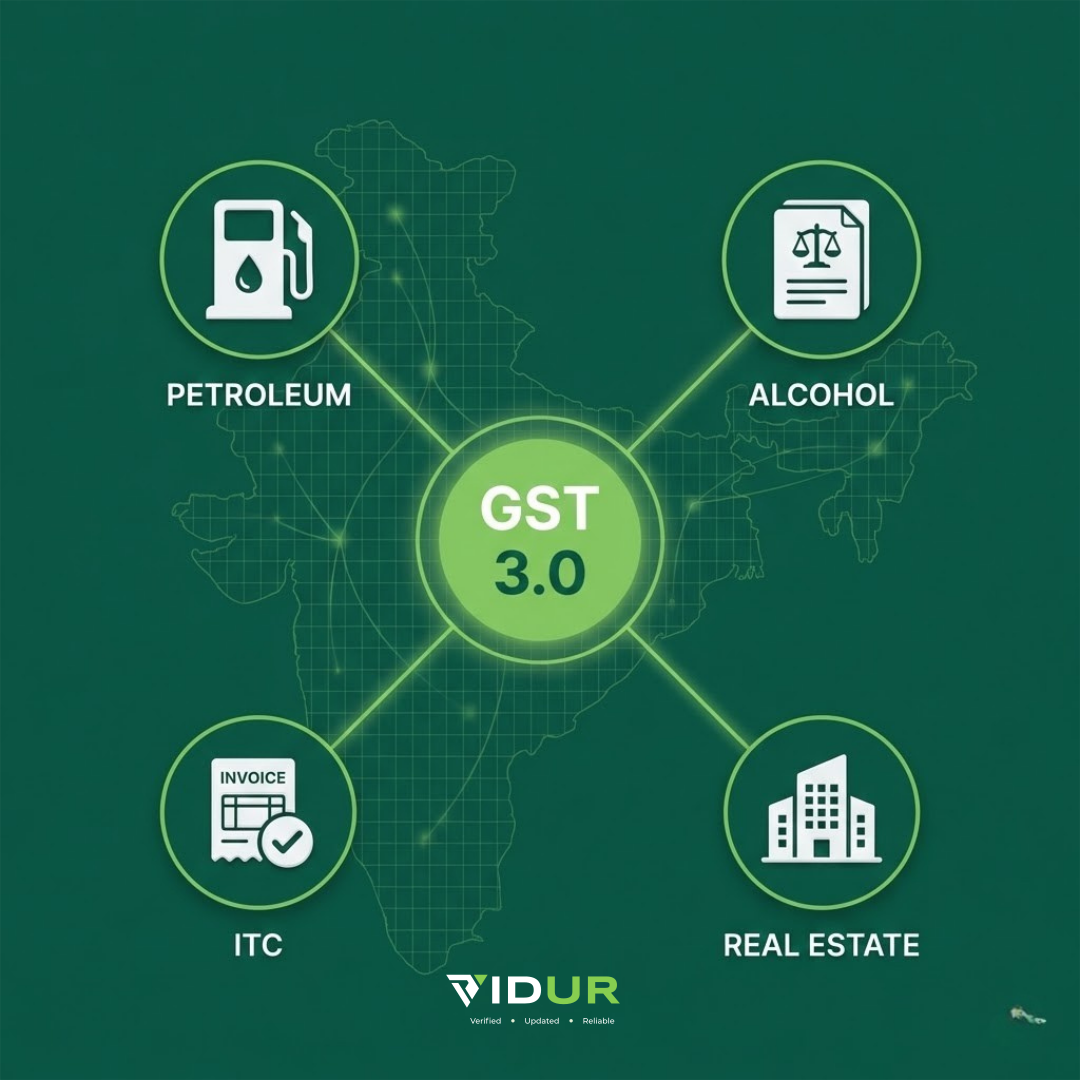


India is rolling out the biggest overhaul of GST since 2017. Popularly called “GST 2.0”, this reform is not just another round of notifications and circulars – it is a complete shift to a tech-driven, risk-based compliance regime.
For Chartered Accountants (CAs) and Tax Lawyers, this is a make-or-break moment. Those who understand GST 2.0 early, retool their internal processes, and leverage technology will define the next decade of indirect tax practice in India.
In this article, we break down:
- What GST 2.0 really means for practitioners
- The three core pillars you must master
- How VIDUR, an AI-powered tax assistant, helps you stay compliant, fast, and future-ready
What Is GST 2.0?
GST 2.0 is a broad term used for the new wave of reforms in India’s GST regime that focuses on:
- Rate rationalisation
- Automated, data-driven compliance
- Sharper enforcement backed by technology and analytics
The goal is clear: fewer slabs, higher transparency, stronger data-matching, and quicker action on non-compliance.
For CAs and tax lawyers, this means:
- Relearning rate structures
- Rewiring compliance workflows
- Preparing clients for higher scrutiny and faster litigation cycles
Pillar 1: Rate Rationalisation and Financial Impact
The first big shift under GST 2.0 is tax rate rationalisation. The slab structure is being simplified into:
- 5% – Merit Rate
- 18% – Standard Rate
- 40% – Demerit Rate for luxury and sin goods
What This Means for Your Practice
- Rapid Reclassification of Goods & Services
- You’ll need to revisit HSN/SAC classification for every major client.
- Incorrect classification now directly affects pricing, margins, and audit risk.
- You’ll need to revisit HSN/SAC classification for every major client.
- Anti-Profiteering & Pricing Impact
- Any rate reduction or change must be mirrored in pricing.
- Failure to pass on benefits can trigger investigations and penalties.
- Any rate reduction or change must be mirrored in pricing.
- Fixing Inverted Duty Structures (IDS)
- Rationalisation aims to address Inverted Duty Structure issues, especially for manufacturers and exporters.
- Refund computation and planning will change, and you’ll need updated workings and templates.
- Rationalisation aims to address Inverted Duty Structure issues, especially for manufacturers and exporters.
Bottom line: Rate rationalisation under GST 2.0 is not just a legal update — it’s a P&L level discussion with every major client.
Pillar 2: Compliance Automation and the Tech Shift
GST 2.0 moves India decisively from manual checks to automated, risk-based compliance. This demands better data discipline and near real-time reconciliations.
1. Tightened ITC Discipline
- Two-way invoice validation and automated risk scoring now power a “Trust but Verify” approach.
- Rule 86A ITC blocking will increasingly be driven by data mismatches and risk flags.
- You’ll need monthly (or even more frequent) ITC reconciliations as a standard, non-negotiable process.
2. Mandatory ISD for Multi-location Businesses
- Input Service Distributor (ISD) registration is now mandatory in more scenarios.
- Groups and multi-location entities must restructure internal accounting and invoice flows to remain compliant.
- Errors in distribution can result in cascading disputes across multiple registrations.
3. Integrated E-Compliance
GST 2.0 is pushing towards a single connected compliance flow:
- E-invoicing
- E-way bills
- GST returns
are increasingly integrated, with extended but structured reporting windows for e-invoices covering more taxpayers.
This means:
- A mistake at the e-invoice stage can ripple into e-way bill mismatches and GSTR discrepancies.
- System errors are now more likely to translate into show cause notices (SCNs) and audit triggers.
Pillar 3: Enforcement, Litigation, and Inter-linkages
With GST 2.0, enforcement is getting smarter, faster, and more interconnected.
Key Shifts You Must Track
- AI-Driven Discrepancy Flagging
- Automated tools can now flag mismatches and auto-generate DRC-01A intimation.
- Early response strategy is critical to prevent escalation.
- Automated tools can now flag mismatches and auto-generate DRC-01A intimation.
- Expanded Section 83 Attachment Powers
- Wider powers to provisionally attach bank accounts and properties means higher stakes even during investigation.
- Wider powers to provisionally attach bank accounts and properties means higher stakes even during investigation.
- GSTAT & Faster Refunds
- With GSTAT becoming operational, litigation backlogs are expected to reduce.
- Section 54(6) changes are aimed at faster provisional refunds, particularly in IDS cases.
- With GSTAT becoming operational, litigation backlogs are expected to reduce.
- Cross-Law Linkages: GST + IBC + FEMA + SEBI/CCI
- GST disputes don’t live in isolation anymore.
- For large corporates, there are direct touchpoints with IBC, FEMA, SEBI, and CCI across investigations, restructurings, and transactions.
- GST disputes don’t live in isolation anymore.
Why GST 2.0 Is a Turning Point for CAs & Tax Lawyers
Under GST 2.0, your role evolves from being just a return-filing expert to a:
- Risk strategist
- Litigation architect
- Cross-law advisor
Clients will expect you to:
- Interpret frequent changes quickly,
- Provide clear, actionable answers on complex fact patterns, and
- Back every view with strong citations from law, notifications, and case law.
This is where AI-powered tools like VIDUR can transform how you work.
The VIDUR Advantage: Your Dynamic Knowledge Engine for GST 2.0
VIDUR is an AI legal assistant built specifically for tax and regulatory professionals in India. For GST 2.0, it acts as a dynamic knowledge engine, combining:
1. Static Knowledge (Foundational Layer)
- Ingestion of 150+ law books, including core titles on GST, Customs, and Excise.
- This gives you section-wise context, explanations, and statutory references in one place.
2. Dynamic Knowledge (Live Updates Layer)
- A dedicated in-house team of Lawyers and CAs feeds in:
- Latest circulars and notifications
- Key High Court and Supreme Court judgments
- Important changes from CBIC and other authorities
- Latest circulars and notifications
This dual engine ensures your answers are both legally sound and fully up to date.
Try VIDUR Now: https://ai.vidur.in
Common GST 2.0 Challenges — And How VIDUR Helps
Here’s how VIDUR fits into daily GST 2.0 practice for CAs and tax lawyers:
1. ITC Eligibility Disputes
- Problem: Constant disputes around Rule 86A, Section 16 conditions, and blocked credit.
- VIDUR Advantage:
- Pulls every new HC/SC ruling on ITC eligibility.
- Gives you consolidated, citation-backed answers you can rely on while advising or drafting replies.
- Pulls every new HC/SC ruling on ITC eligibility.
2. Rate Transition & HSN/SAC Reclassification
- Problem: Moving to new slabs (5%, 18%, 40%) needs quick, accurate reclassification.
- VIDUR Advantage:
- Provides instant references on new classifications, cross-linked with existing jurisprudence.
- Reduces the risk of automated audit flags due to wrong HSN/SAC.
- Provides instant references on new classifications, cross-linked with existing jurisprudence.
3. Enforcement & Litigation Defence
- Problem: Rising number of SCNs, provisional attachments, and summons.
- VIDUR Advantage:
- Offers digest-style summaries of key enforcement judgments.
- Gives quick section references and drafting templates for:
- Replies to SCNs
- Summons responses
- Provisional attachment challenges
- Replies to SCNs
- Offers digest-style summaries of key enforcement judgments.
4. Proactive Audit Risk Mitigation
- Problem: Clients fear system-driven scrutiny they don’t fully understand.
- VIDUR Advantage:
- Helps you check HSN/SAC codes and new GST 2.0 rates in seconds.
- Allows you to audit digital footprints before the department does.
- Helps you check HSN/SAC codes and new GST 2.0 rates in seconds.
5. Cross-Law Inter-linkages
- Problem: Complex matters where GST intersects with IBC, FEMA, SEBI, CCI.
- VIDUR Advantage:
- Uses cross-referenced static books + dynamic updates to show you the full legal picture, not just the GST angle.
- Uses cross-referenced static books + dynamic updates to show you the full legal picture, not just the GST angle.
6. Instant, Client-Ready Advisory
- Problem: Clients demand fast, clear answers — often over call or WhatsApp.
- VIDUR Advantage:
- Generates 5-second, citation-backed advisory notes on questions like:
- ITC on CSR spends
- Lease rentals
- Reimbursements & pure agent issues
- ITC on CSR spends
- Helps you respond faster while strengthening your perceived value as a strategic advisor.
- Generates 5-second, citation-backed advisory notes on questions like:

Turning GST 2.0 Into Your Competitive Edge
In GST 2.0, one missed filing window, wrong rate, or ITC position can cost your client crores — and your firm its reputation.
With VIDUR:
- You cut down research time from hours to minutes.
- You get consistent, citation-backed outputs across your team.
- You’re always working with the latest law and jurisprudence, not last year’s position.
GST 2.0 will reward professionals who combine deep subject matter expertise with smart technology.
If you’re a CA or tax lawyer in India, this is the right time to:
- Review your clients’ GST 2.0 readiness
- Standardise your internal GST workflows
- Integrate tools like VIDUR into your daily drafting, research, and advisory work
Ready to transform your GST practice?
Try VIDUR Now: https://ai.vidur.in
Explore how VIDUR can convert the complexity of GST 2.0 into your biggest competitive advantage.
FAQs
Q1. What is GST 2.0 in India?
GST 2.0 refers to the next phase of reforms in India’s GST regime focused on rate rationalisation, automated compliance, and data-driven enforcement.
Q2. How does GST 2.0 impact CAs and tax lawyers?
CAs and tax lawyers must adapt to new rate structures, stricter ITC rules, mandatory ISD, integrated e-compliance systems, and sharper, tech-backed enforcement.
Q3. How can VIDUR help with GST 2.0 compliance?
VIDUR offers an AI-powered research and drafting assistant that combines 150+ law books with daily updates, giving instant, citation-backed answers for ITC disputes, rate classification, litigation defence, and audit risk mitigation