


A practical guide to selling before the IPO, holding through listing, or participating in the OFS
With NSE moving closer to its proposed IPO, existing shareholders holding unlisted NSE shares need to evaluate an important question: should they exit before listing, continue holding through the listing process, or participate in the Offer for Sale (OFS), if eligible?
Each option may have different implications from the perspective of holding period, liquidity, lock-in requirements and capital-gains taxation.
This note examines the principal exit alternatives available to existing NSE shareholders and the tax considerations associated with each route.
Option 1: Sale of NSE Shares Before Listing
The first option is to sell the shares in the unlisted market before NSE gets listed. This may provide an immediate exit and eliminate the uncertainty associated with waiting for the IPO and subsequent market trading.
The key consideration is capital-gains taxation.
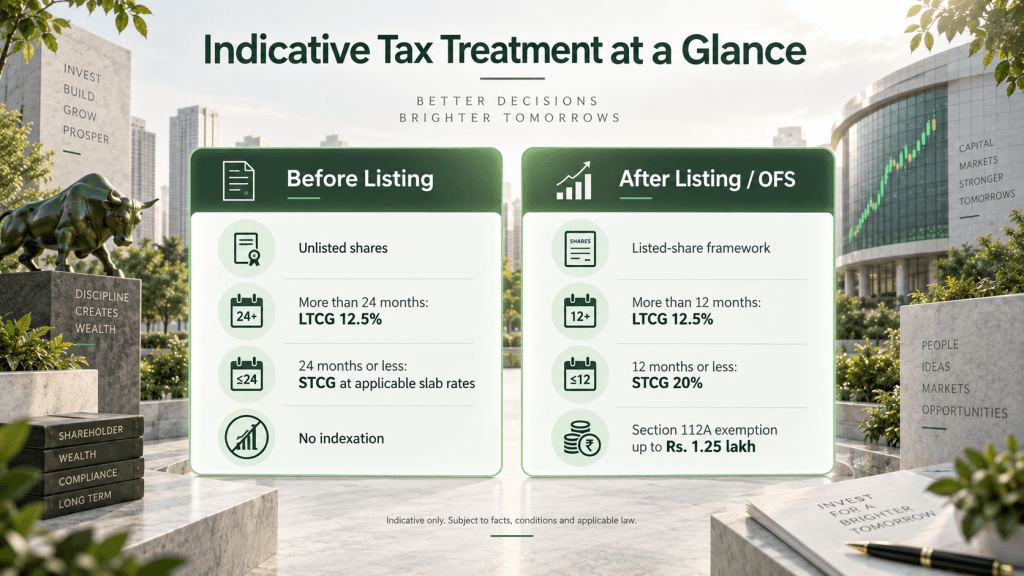
For an individual investor holding NSE shares as an investment, unlisted equity shares generally become long-term capital assets after a holding period of more than 24 months.
For transfers on or after July 23, 2024, long-term capital gains on unlisted securities are generally taxed at 12.5%, without indexation.
If the shares have been held for 24 months or less, the gain is generally treated as short-term capital gain and taxed according to the applicable slab rates, which can go up to 30% depending on the income of the existing shareholder.
Option 2: Continue Holding Shares Through Listing
Existing shareholders may also choose to continue holding their shares through the listing process.
Pre-IPO shares held by non-promoters are typically subject to a mandatory 6-month lock-in period from the date of allotment in the IPO. Accordingly, such shares may not be available for sale on the listing day, exposing the shareholder to market movements during the lock-in period.
The holding period is calculated from the original date on which the unlisted shares were acquired, and not from the date on which they become listed.
For listed equity shares, the long-term holding-period threshold is generally 12 months, compared with 24 months for unlisted shares. Long-term gains on qualifying listed equity transactions are currently taxed at 12.5%, after allowing for the exemption of Rs. 1.25 lakh under Section 112A.
Where the holding period is 12 months or less, short-term capital gains are taxed at a flat 20%.

Option 3: Sale Through the IPO Offer for Sale (OFS), if Eligible
Another possibility is to sell eligible shares through the IPO’s Offer for Sale.
VIDUR AI | Research • Drafting • Updates • Advisory
However, existing NSE shareholders should not assume that merely holding NSE shares automatically entitles them to participate in the OFS.
The reported IPO structure includes eligibility requirements for existing shareholders, including a one-year holding condition for participation in the OFS. Investors who purchased shares shortly before the IPO may therefore not qualify for this route.
For an eligible shareholder, the OFS may allow the shareholder to sell all eligible shares at the official IPO price, or sell only a portion and retain the balance.
Based on the treatment described in this note, gains may be taxed at 20% for short-term capital gains where the holding period is less than 12 months, and at 12.5% for long-term capital gains where the holding period exceeds 12 months.
Comparison at a Glance
| Exit route | Holding-period consideration | Indicative tax treatment* | Key consideration |
|---|---|---|---|
| Sell before IPO | Unlisted-share rules; 24-month threshold referenced in this note | STCG/LTCG depending on holding period | Immediate liquidity; unlisted-market pricing and tax impact |
| Hold through listing | Original acquisition date continues to remain relevant | Listed-share regime may apply on subsequent qualifying sale | Lock-in period and post-listing market movement |
| Participate in OFS | Subject to OFS eligibility and holding conditions | Treatment depends on applicable listed-equity/OFS provisions | Eligibility, IPO price and quantity accepted in OFS |
Indicative only and subject to the applicable provisions, conditions and shareholder-specific facts.
Key Considerations for Existing Shareholders
- Acquisition date and cost of acquisition for each tranche of shares;
- Holding period on the proposed date of transfer;
- Eligibility, if any, for participation in the OFS;
- Applicable lock-in restrictions;
- Comparative tax impact of a pre-listing and post-listing exit;
- Liquidity requirements and exposure to post-listing price movements.
The appropriate approach may differ depending on the shareholder’s acquisition history, tax profile and proposed exit timeline.
VIDUR Research Note
Researching a similar tax question? Use VIDUR AI to research applicable provisions, case laws, circulars and tax implications with source-backed answers.