

Two Acts. One Profession. A New Way of Working.
Imagine opening your tax practice one morning and discovering that the entire country is running on two operating systems. This is what we are currently working into-an unprecedented era in Indian taxation—a true “Dual Operating System” environment.
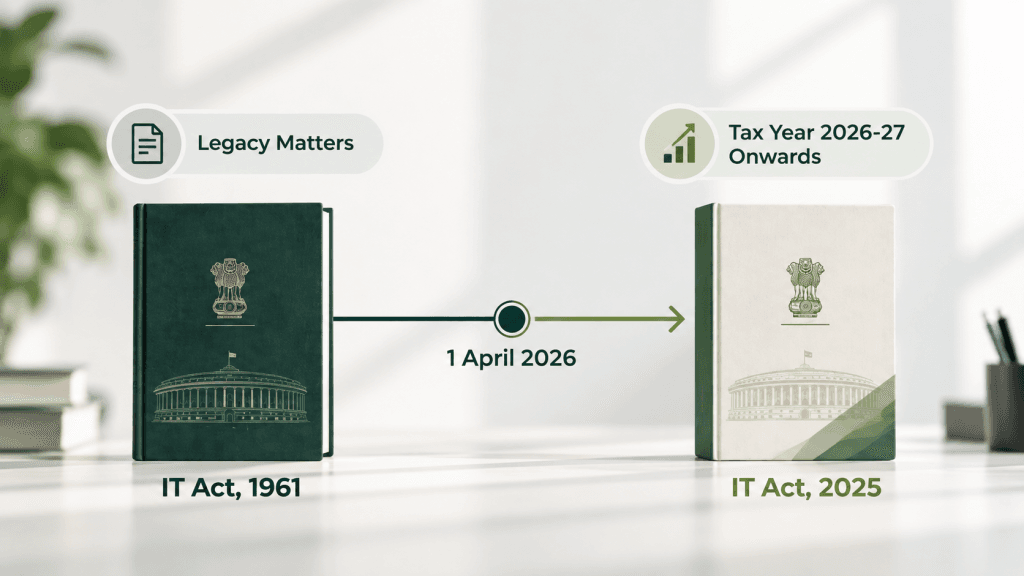
The older system—the Income-tax Act, 1961—still controls the past. The newer system—the Income-tax Act, 2025—governs the future. Both are relevant, both demand attention, and both may need to be used within the same client engagement.
This is the new reality for Chartered Accountants.
The Income Tax Act, 1961 may no longer govern new Tax Years after its replacement, but it will continue to influence earlier assessment years, pending scrutiny proceedings, appeals, reassessments, and other legacy matters. At the same time, transactions arising under the new Tax Year framework will need to be analyzed under the Income Tax Act, 2025.
The challenge is not simply learning a new law. It is learning when to use which law.
The Shift: What the “Dual Regime” Actually Means
The new Income Tax Act, 2025 consolidates over 800 sections into just 536 sections across 23 chapters, aiming to simplify language and reduce litigation. One of the most significant changes is the replacement of the confusing “Previous Year” and “Assessment Year” concepts with a unified “Tax Year” (effective from FY 2026-27, now referred to as Tax Year 2026-27).
Because Section 536 of the Income Tax Act, 2025 dictates how the old proceedings continue, CAs must constantly toggle between two distinct statutory realities. Handling a scrutiny notice for AY 2025-26? You are in the Income Tax Act, 1961. Structuring a joint venture in December 2026? You are firmly in the Income Tax Act, 2025.
The Diagnostic Checklist: Establishing the Ground Rules
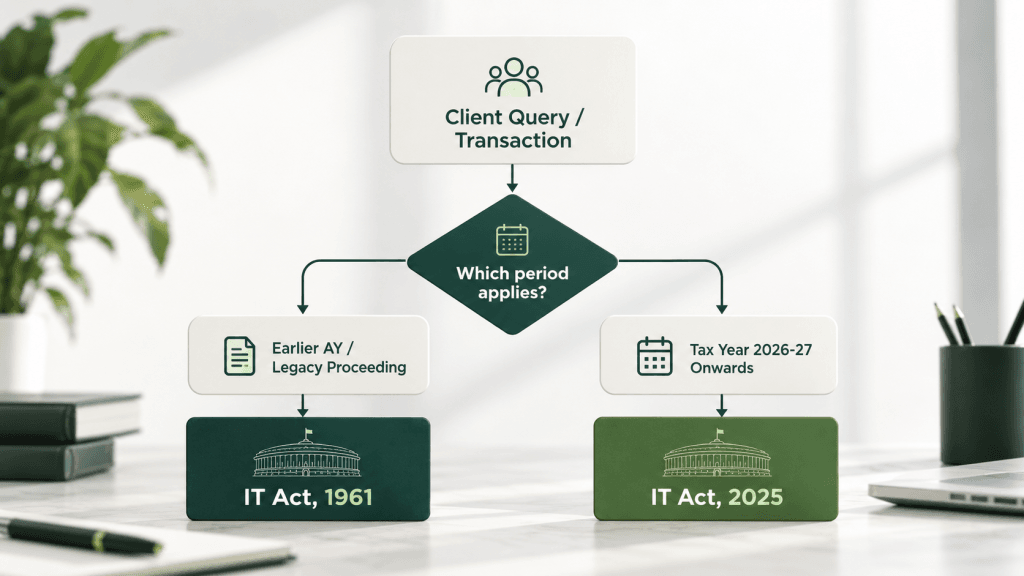
Before dispensing advice, filing a return, or representing a client, CAs must establish absolute legislative clarity. Develop a standard diagnostic intake checklist for every query:
- Check the Timeline: Pinpoint the exact timeline. Does the transaction fall squarely under a legacy Assessment Year governed by the Income Tax Act, 1961 or has it crossed the threshold into a “Tax Year” under the Income Tax Act, 2025 jurisdiction?
- Identify the Rules: Identify the active rules of engagement. Which specific legislative framework applies? You must map the old Income Tax Act, 1961 sections to the newly reorganized Income Tax Act, 2025 sections to ensure continuity.
- Verify the Paperwork: Double-check the paperwork. Are you using the correct form, report, certificate or digital compliance portal for the applicable Act? Submitting under the wrong regime could render filings invalid and trigger automated penalties.
- Confirm the Case Laws: Validate your case laws. Never assume legacy rulings still apply. Are there new transitional guidelines under Section 536 under the new act or recent CBDT circulars that render old judicial precedents obsolete?
Concrete Examples of the Transition
To understand the practical impact, let’s look at how everyday advisory changes:
- The TDS Matrix: Suppose a client is making a professional fee payment. Under the Income Tax Act, 1961 you would instinctively refer to Section 194J and its associated case laws. Under the Income Tax Act, 2025 the provisions will be guided by Section 393.
- Business Setup and Timelines: Under the old regime, if a business was set up on December 1, you had to carefully explain the “Previous Year” ending March 31 versus the subsequent “Assessment Year.” Now, under the Income Tax Act, 2025 if a business starts on December 1, 2026, the “Tax Year” simply runs from December 1, 2026, to March 31, 2027. Your advisory must reflect this new terminology to avoid client confusion.
Precision Advisory with VIDUR AI: Your AI Research Partner
Managing two massive tax codes simultaneously strains even the most experienced teams and no professional should be expected to memorize every section of two large tax codes while also tracking notifications, circulars, rules, forms, and case law. And also, human memory will instinctively default to the Income Tax Act, 1961 increasing the risk of citation errors.
This is where VIDUR AI can become a powerful research partner.
- Intelligent Section Mapping: Don’t waste billable hours manually cross-referencing the old Act against the new 536 sections. VIDUR can instantly map legacy provisions to their modern equivalents, highlighting exactly what textual nuances have changed.
- Ask Better Questions: Formulate complex legal inquiries that specifically account for the transition.
- Find Trusted Sources: VIDUR AI retrieves source-backed materials that you can rely on.
- Draft Clear, Era-Specific Advice: Generate initial drafts for client advisory. VIDUR AI ensures these communications clearly articulate which law is being applied and why, translating complex dual-act jargon (like replacing “Assessment Year” with “Tax Year”) into plain English for your clients.
Conclusion
The dual operating system of our tax regime isn’t just a temporary hurdle; it is the new professional reality that will define practice for the next several years. Relying on memory and physical textbooks is a liability when navigating the sunset of a 60-year-old law and the dawn of a digital-first tax code. By systematizing your initial research and heavily leveraging VIDUR AI for precise legislative interpretation, you can navigate this transition with absolute confidence. Empower your team, modernize your workflow, and ensure your firm continues to provide the most accurate, legally sound advice possible during this historic shift.