

A Big Blow to Retrospective Legislative Validation of Reassessment Notices
Introduction
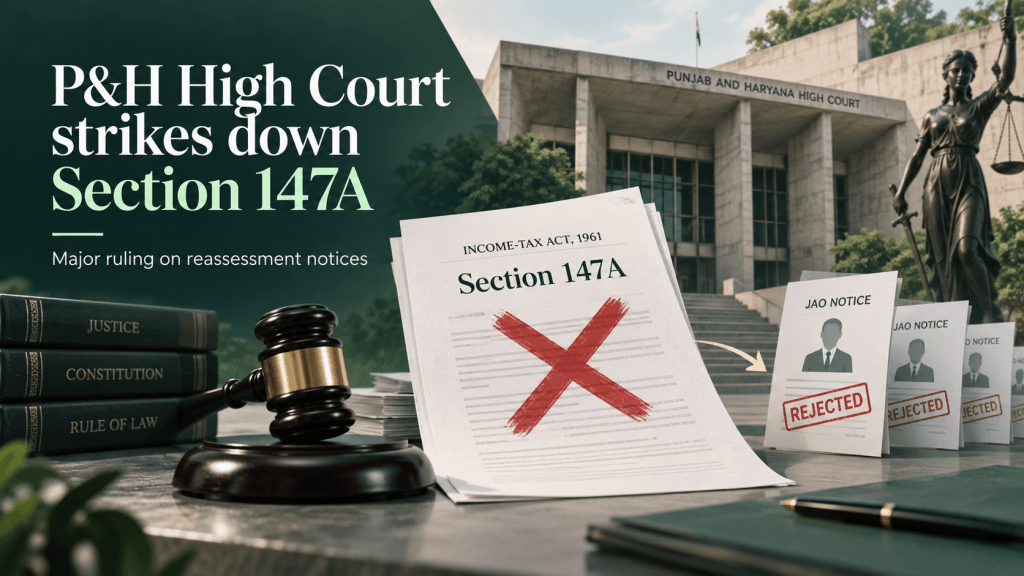
In a significant ruling with far-reaching implications for income tax reassessment proceedings across the country, the Punjab & Haryana High Court in major case Jyoti Sareen v. Union of India and others has struck down Section 147A of the Income-tax Act, 1961, declaring the provision unconstitutional. The Bench of Justice Deepak Sibal and Justice Rupinderjit Chahal delivered this decision, holding that Parliament had overstepped constitutional limits by attempting to retrospectively nullify binding judicial pronouncements.
What is Section 147A?
Section 147A was inserted into the Income-tax Act, 1961 by the Finance Act, 2026, with retrospective effect from April 1, 2021. The provision states that, for the purposes of Sections 148 and 148A, the term “Assessing Officer” would mean an Assessing Officer other than the National Faceless Assessment Centre (NFAC).
In effect, Section 147A was designed to validate reassessment notices issued by the Jurisdictional Assessing Officer (JAO), as opposed to the Faceless Assessing Officer (FAO), under the faceless assessment regime. The corresponding provision under the new Income-tax Act, 2025 is Section 279(3).
The JAO vs. FAO Controversy
To understand why this provision was introduced and why it has now been struck down it is important to trace the background of the dispute:
- Section 151A of the ITA, 1961 empowered the Central Government to frame a scheme for faceless reassessment, covering the issuance of notices under Section 148 and proceedings under Section 148A.
- Pursuant to this power, the Government notified the e-Assessment of Income Escaping Assessment Scheme, 2022, mandating that reassessment proceedings operate through a dynamic and automated allocation mechanism.
- A dispute soon arose as to whether JAOs or FAOs had the jurisdiction to handle a given reassessment case.
- Several High Courts including the Punjab & Haryana High Court itself, in Income Tax Officer, Ward 2(1), Chandigarh & Ors. v. Tej Partap Singh held that where the faceless scheme applied, only the FAO (selected through random, automated allocation) had jurisdiction to issue a notice under Section 148. Orders under Section 148A(d) and consequent Section 148 notices issued by JAOs were accordingly quashed.
- However, certain other High Courts took a contrary view, upholding the authority of JAOs to initiate reassessment proceedings.
This divergence led to the Revenue challenging the adverse rulings before the Supreme Court.
The Retrospective Amendment: Parliament’s Response
While the Revenue’s appeals were pending before the Supreme Court, Parliament inserted Section 147A with retrospective effect from April 1, 2021, through the Finance Act, 2026. The amendment clarified that, notwithstanding anything else in the law, an “Assessing Officer” for the purposes of Sections 148 and 148A would exclude the NFAC and any Assessment Unit.
The clear legislative intent was to establish retrospectively that the JAO alone had jurisdiction to initiate reassessment, effectively overriding the earlier judicial rulings that had struck down JAO-issued notices.
Following this amendment, the Supreme Court remitted the batch of pending JAO-FAO matters back to the respective High Courts for fresh consideration in light of the retrospective insertion of Section 147A, and directed petitioners to challenge the validity of the amendment itself before the High Courts.
The Constitutional Conflict: Why the High Court Struck It Down
This is where the case moves from a technical tax dispute into a constitutional law question specifically, one concerning the separation of powers between the legislature and the judiciary.
Senior Advocates Dr. Sanjay Bansal, Radhika Suri, Sandeep Goyal, and others argued before the Court that: Parliament cannot retrospectively amend the law in a manner that nullifies a binding judgment of a constitutional court and doing so would amount to the legislature effectively overturning a judicial decision through legislative fiat i.e. a power it does not possess under the Constitution. The court have relied on cases such as SR Bhagwat v. State of Mysore and Shri Prithvi Cotton Mills v. Broach Borough Municipality and others etc where it was collectively established that while the legislature can retrospectively cure a defect in law, it cannot use retrospective legislation as a device to directly annul a judicial verdict without addressing the substantive basis on which that verdict rested.
The HC held that the legislature cannot set at naught on the judgments of constitutional courts. An amendment cannot be used as a tool to overturn or set aside a judicial decision by simply introducing a new provision with retrospective effect. A retrospective amendment is permissible only if it removes the very basis of the court’s earlier decision. Merely disagreeing with a judgment and legislatively “correcting” it without altering its underlying foundation is constitutionally impermissible. Section 147A failed this test. It only excluded the NFAC and Assessment Units under Section 144B(3) from the definition of “Assessing Officer.” It did not touch Section 151A, which empowers the faceless reassessment scheme. However, the e-Assessment Scheme, 2022 was never withdrawn and the mandate for automated, random allocation and dynamic jurisdiction for issuing Section 148 notices remained fully intact.
Since Section 147A left untouched the very foundation of the earlier judicial rulings, the statutory mandate for faceless, randomly allocated reassessment could not retrospectively cure the invalidity of JAO-issued notices merely by redefining who qualifies as an “Assessing Office”.
Implications of the Ruling
- The Court did not merely leave JAO-issued notices open to challenge it affirmatively set aside the Section 148 notices issued to the petitioners in this batch, holding that they had not been issued through randomised, faceless allocation as mandated under Section 151A and the e-Assessment Scheme, 2022. Other JAO-issued reassessment notices from April 1, 2021 onward that Section 147A sought to validate remain vulnerable to challenge on similar jurisdictional grounds in the Punjab & Haryana High Court’s jurisdiction.
- The ruling reinforces the faceless assessment mandate under Section 151A and the e-Assessment Scheme, 2022, since the Court held that this framework continues to prevail.
- It sets up a potential conflict between High Courts, given that some other High Courts have taken a contrary view upholding JAO authority and that this divergence may eventually require Supreme Court intervention for a definitive resolution.
- The judgment is an important reaffirmation of the constitutional principle of separation of powers, limiting Parliament’s ability to use retrospective legislation as a substitute for an appeal against unfavourable court rulings.
Conclusion
The Punjab & Haryana High Court’s decision to strike down Section 147A underscores a fundamental constitutional safeguard: the legislature may make laws, but it cannot use the law-making process to directly overturn judicial verdicts without altering the very foundation on which those verdicts rest.
Read the full order on VIDUR: ai.vidur.in
1 CWP No.15791-2024 (O&M)
2 [1995] 6 SCC 16 (SC)
3 (1969) 2 SCC 283