


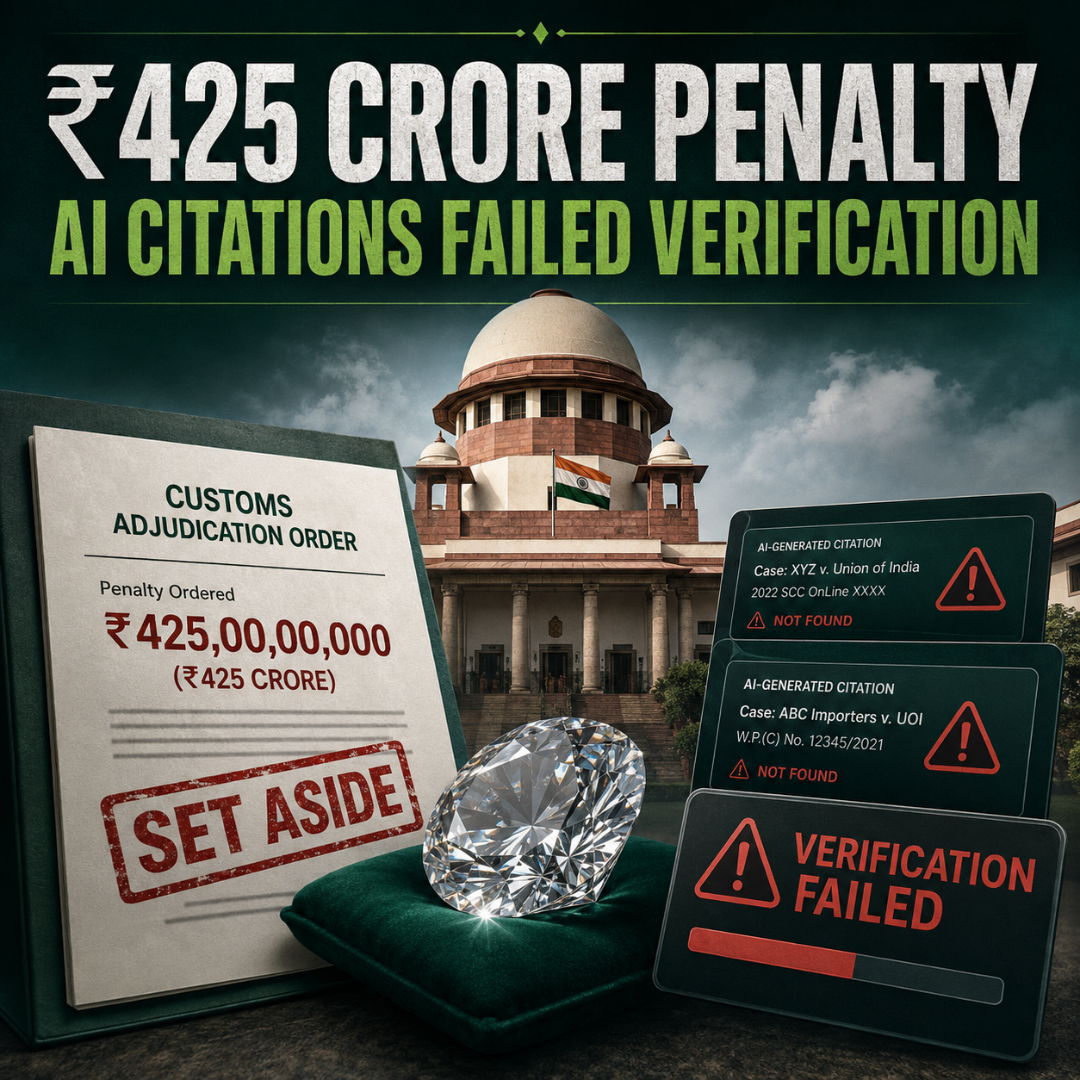
In the recent case of Vijay Ghanshyam Gadiya v. Union of India & Anr. that just came out of the Supreme Court of India is worth talking about, and it’s not really about diamonds, even though diamonds are how it started. A shipment of diamonds has come in, and something about it doesn’t add up they’re being declared as lab-grown, but an officer suspects they’re actually natural stones, quietly passed off as the cheaper kind to dodge a heavier custom. The officer digs in, builds a case, and eventually signs an order slapping the importer, a man named Vijay Ghanshyam Gadiya, with a penalty of ₹425,27,99,100. Gadiya fought it. He lost at the Gujarat High Court. By the time his case reached the Supreme Court of India, it looked like the kind of appeal that ends quietly a technical customs dispute, a man arguing about diamonds, a bench likely to uphold what two authorities had already decided.
However, that is not what happened.

The result is a significant Supreme Court warning on AI-hallucinated legal citations in adjudicatory orders.
A Strange Argument, and a Stranger Discovery
Gadiya’s lawyers didn’t spend much time on the diamonds. Instead, they said something that must have made the courtroom go quiet: the case law the customs officer had cited to justify the ₹425 crore penalty wasn’t real. The officer, they argued, had used AI to help draft the order and the AI had simply invented precedent.
It’s the kind of claim that’s easy to make and hard to prove. So the judges did something refreshingly old-fashioned: they checked. Justices Dipankar Datta and Sheel Nagu went through the citations in the penalty order one by one. However, what they found wasn’t a stray error. Some of the judgments cited in the order didn’t exist at all and no such case had ever been decided, the citations were fabricated from nothing. Other cases were real, genuine judgments that do exist in law reports, but the legal principle the officer said they established simply wasn’t in them. Someone or something had confidently attached a legal argument to a case that never actually made that argument.
It’s the exact failure mode anyone who’s used an AI chatbot will recognise instantly: ask it for a source, and it hands you something that looks perfect with right format, right tone, entirely convincing and is quietly, completely made up. Except this time it wasn’t a wrong answer in a chat window. It was the legal backbone of an order demanding hundreds of crores from a real person.
This Court Had Seen It Before and Had Already Said: No Exception
What made the Supreme Court’s response so sharp is that this wasn’t uncharted territory for them. They reached back to an earlier decision, Pooja Ramesh Singh v. Jammu & Kashmir Bank Ltd., where the Court had already confronted AI hallucination in legal proceedings and laid down, in fairly blunt language, exactly how it intends to treat it. In its own words:
- Citing AI-generated case law without checking it is misconduct on a lawyer’s part.
- Relying on hallucinated material as if it were genuine precedent is a serious lapse whether it’s a judge doing it, or, by extension, any official making a legally binding decision.
- It makes no difference how small the fabrication is. Even an “iota” of fake or hallucinated material is enough for the decision to be set aside, regardless of whether it actually changed the result. The mere presence of it is treated as a violation of the whole process.
That third point is really the heart of it. This isn’t a court asking, “did the fake case law actually tip the scales?” It’s a court asking, “was there any fake case law in the mix at all?” One yes, and the entire decision is compromised with no partial credit, no benefit of the doubt.
The Court Isn’t Against AI but Just Against Blind Trust in It
To be fair to the bench, they weren’t saying AI has no place in the legal system. They actually mentioned that the Supreme Court itself is working on draft rules for how AI should be used in courts, and that using AI as a research aid isn’t some forbidden thing.
But they put it in a way that’s easy to remember: AI can be training wheels, but you can’t let it sit in the pilot’s seat. It can help a person get started. It can’t be the thing actually making the call. A human still has to check the work.
For source-linked professional research, explore VIDUR AI.
So the ₹425 Crore Penalty Just Disappeared
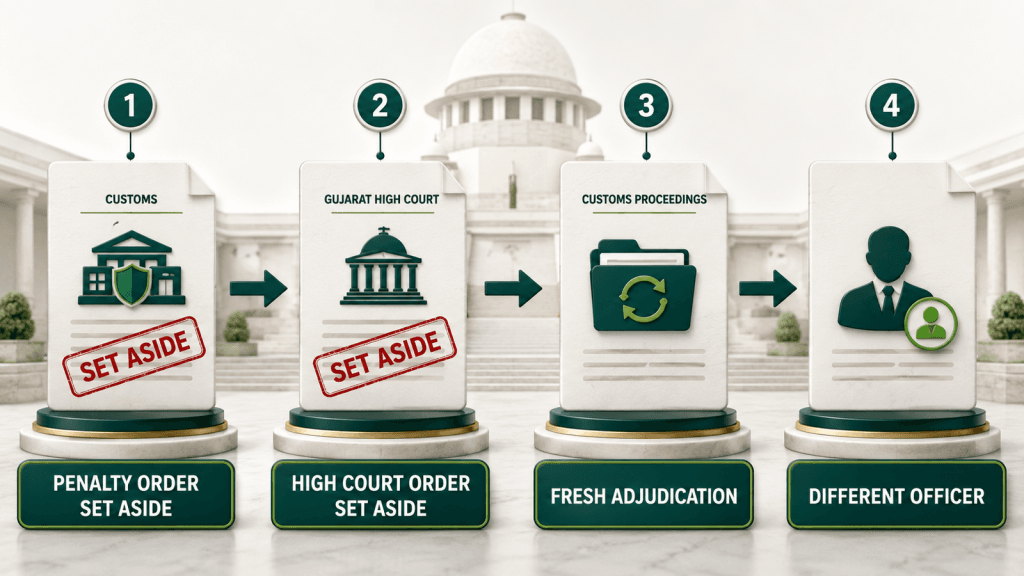
Because the fabricated case law was tangled into the reasoning of the original order, the Supreme Court didn’t try to salvage any part of it. It set aside the Gujarat High Court’s ruling and the original penalty order in full with both gone. The matter goes back to square one, to be decided fresh, but with one important condition, it has to be handled by a different officer, not the one who signed the original order.
The Court reiterated that it’s now up to the department itself to decide whether disciplinary action is warranted against the officer who authored the flawed order. That’s not the language of “mistakes happen.” That’s a court leaving the door open for consequences.
Why a Diamond Dispute in Surat Matters to Everyone Else
Strip away the tariffs and the gemstones, and what you’re left with is a story that’s going to repeat itself in offices that have nothing to do with customs or diamonds. Lawyers are using AI to draft. Officials are using it to research. Anyone producing documents with legal weight is increasingly leaning on tools that can, without any hint of hesitation, invent a case, a quote, a statute anything and present it with total confidence.
The unsettling part is that fabricated citations don’t look fabricated. They read exactly like the real thing: correct formatting, authoritative tone, the unmistakable cadence of a court judgment. The only way anyone catches it is by actually going back and checking, source by source, the way these two judges did.
This case is a rare instance of that check happening before the damage became permanent where a man was still going to have to fight a fresh proceeding, but at least not one built on a foundation that never existed. And the Supreme Court used the moment to say, plainly, what it expects going forward: verify everything, excuse nothing, and treat a single fake citation as reason enough to tear the whole decision down.