

“So, you’re telling me that just signing off on the financials isn’t enough anymore?” asked Mr. Sharma, a seasoned business owner, looking at his Chartered Accountant, Priya.
Priya nodded, “In today’s environment, Mr. Sharma, my role has expanded. Stakeholders now expect a deeper level of assurance, looking beyond just the numbers to the very integrity of the business.”
The role of an auditor has undergone a quiet revolution. Once seen as a meticulous record-checker, the modern auditor is now expected to be a guardian of trust, a sentinel against misconduct, and a technologically-savvy analyst.
This article explores five key areas where the expectations of auditors have fundamentally shifted, particularly within the Indian context.

1. From Watchdog to Proactive Gatekeeper
The traditional view of an auditor as a “watchdog” who retrospectively checks for errors is outdated.
Today, stakeholders, especially shareholders, expect auditors to be proactive “gatekeepers” who can identify and flag risks before they escalate.
This includes a heightened focus on detecting material fraud, scrutinizing related-party transactions, and providing early warnings on aggressive accounting practices.
2. The Demand for Deeper Transparency
The introduction of Key Audit Matters (KAMs) has transformed the audit report from a boilerplate document into a source of valuable insight.
Investors and regulators now demand clear, entity-specific explanations of significant audit risks and the judgments made by management.
This shift towards transparency means auditors must be skilled communicators, able to articulate complex issues in a way that is meaningful to a wider audience.
3. The Rise of the Regulator and the NFRA Effect
The establishment of the National Financial Reporting Authority has been a game-changer for the audit profession in India.
With its power to inspect, penalize, and debar, the NFRA has ushered in a new era of accountability.
This has led to a clear shift from a principles-based trust model to an enforcement-driven oversight model, where auditors are expected to demonstrate robust documentation and a willingness to challenge management.
4. Embracing Technology and AI
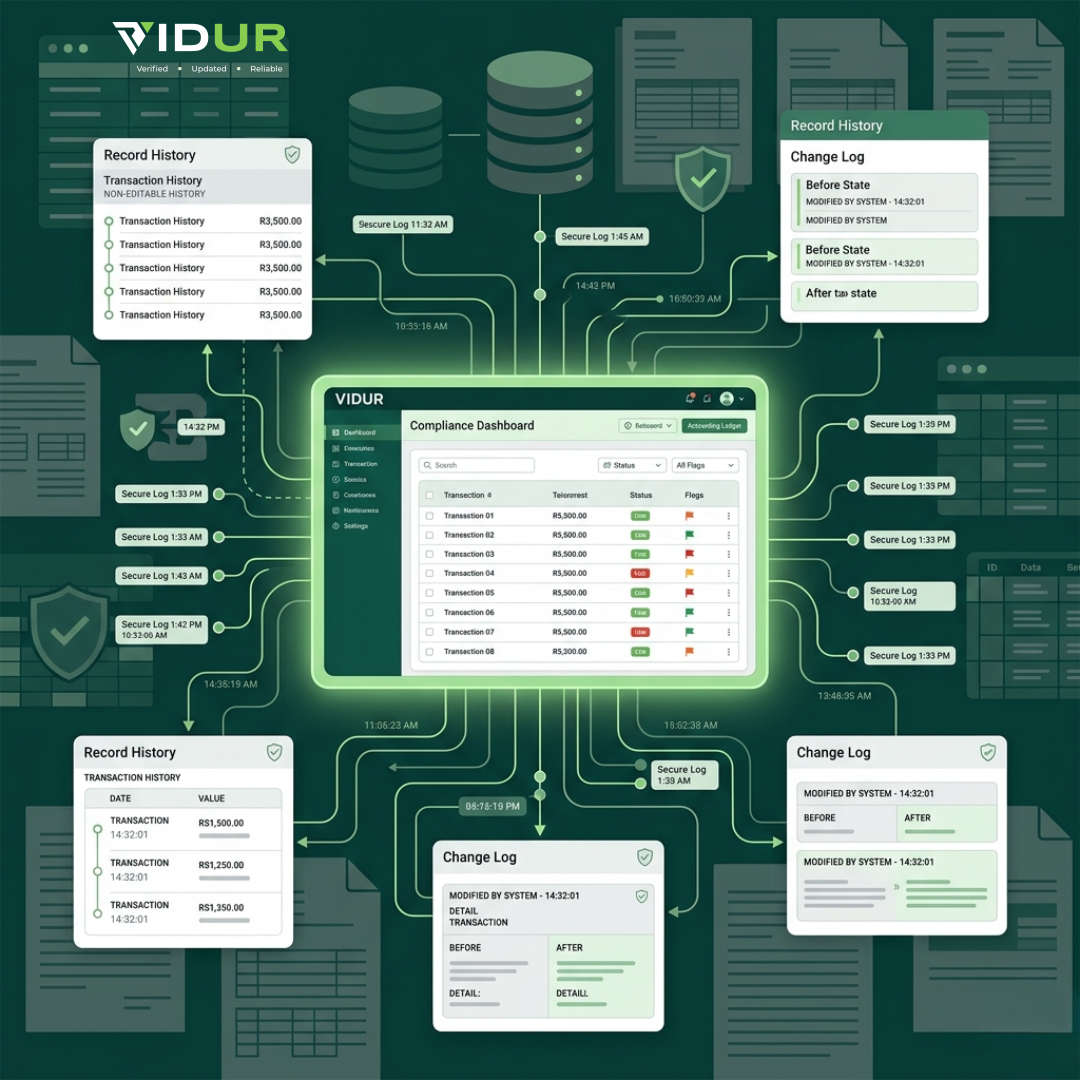
Stakeholders increasingly expect auditors to leverage technology to enhance the effectiveness and efficiency of the audit process.
The use of data analytics, artificial intelligence (AI), and machine learning (ML) is no longer a luxury but a necessity.
It enables auditors to analyze vast amounts of data, identify anomalies, and gain deeper insights into a company’s operations and risk areas.
For instance, AI can flag unusual transactions, such as duplicate payments or invoices processed outside of normal business hours, providing auditors with a powerful tool for fraud detection.
Traditional Audit vs Modern, Tech-Enabled Audit
| Traditional Audit | Modern, Tech-Enabled Audit |
|---|---|
| Manual sampling of transactions | Comprehensive analysis of 100% of transactions |
| Focus on historical data | Real-time and continuous monitoring |
| Reactive identification of issues | Proactive identification of anomalies and risks |
| Limited by human capacity | Augmented by AI and machine learning |
5. The Expanding Horizon: ESG and Non-Financial Assurance
The expectations of auditors are expanding, surpassing the traditional financial statements.
With the introduction of the Business Responsibility and Sustainability Reporting (BRSR) framework in India, there is a growing demand for assurance on non-financial information.
While the role of statutory auditors in ESG assurance is still evolving, stakeholders are looking to the profession to bring the same level of rigor, consistency, and credibility to sustainability disclosures as they do to financial reporting.
The Path Forward: A Sustainable Profession
To meet these evolving expectations, the audit profession must not only adapt its methods but also ensure it remains an attractive career path for the next generation.
This requires a concerted effort from firms, regulators, and educational institutions to foster a culture of continuous learning, technological innovation, and purpose-driven work.
The future of auditing lies in a balanced ecosystem where robust oversight is complemented by a respect for professional judgment, and where auditors are empowered to be true guardians of public trust.
Ready to navigate the complexities of modern legal and financial compliance with confidence?
Discover how VIDUR AI can empower your practice with intelligent, AI-driven insights. Visit us today to learn more and request a demo.