


“Before we close the books on this year, let’s talk about the next one,” a seasoned Chartered Accountant tells his client. “Starting 1 April 2026, we are not dealing with a few tweaks — we are looking at an entirely new Income Tax Act. Being prepared is not just an advantage; it’s a necessity.”
This conversation is playing out in offices across India as taxpayers and professionals brace for a significant overhaul. The Union Budget 2026 has set the stage for the new Income-tax Act, 2025, to replace the six-decade-old 1961 legislation, with a clear focus on simplifying the law, reducing litigation, and improving compliance.
Here are the top 10 changes you need to know.
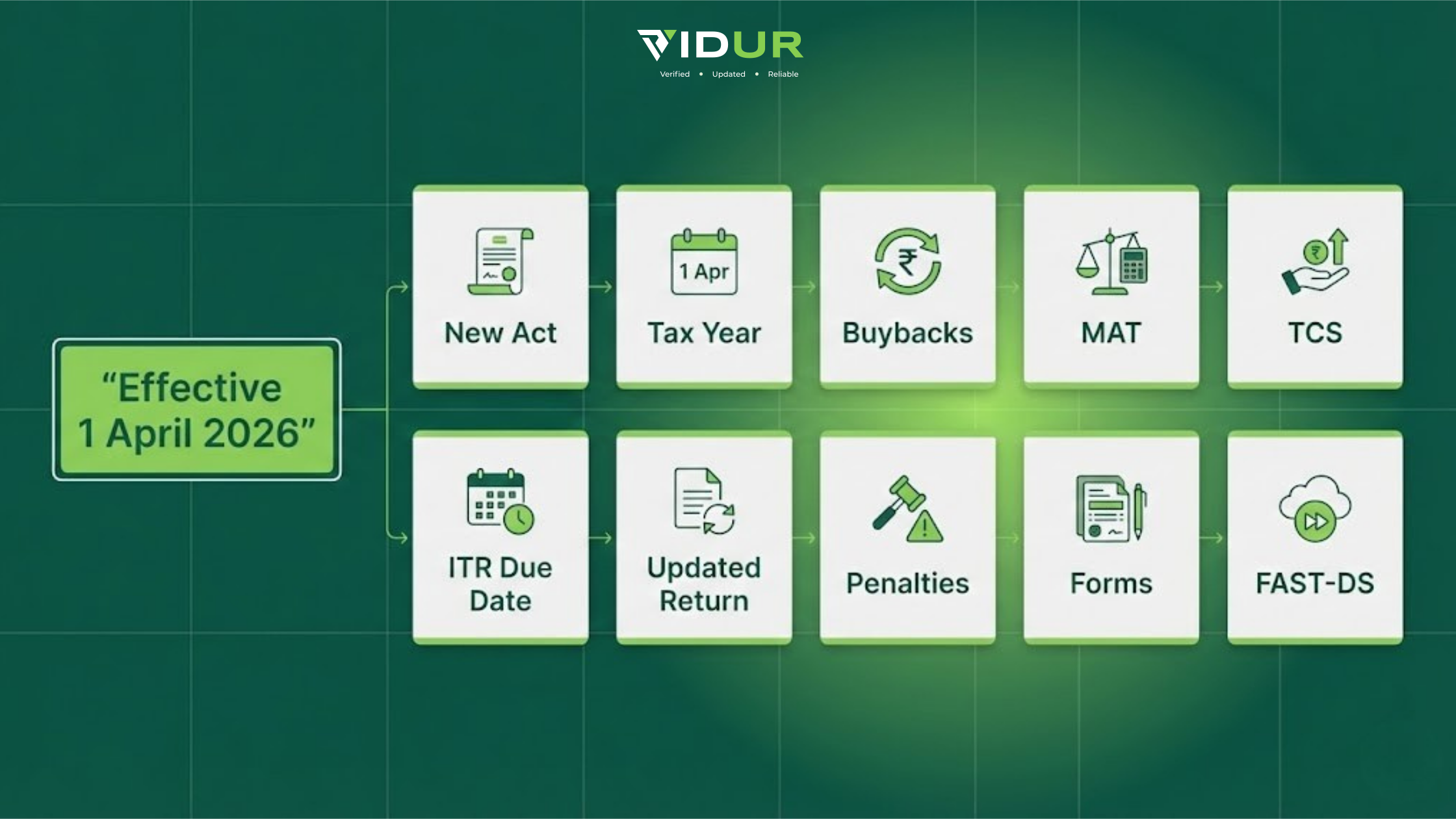
1. The New Income-tax Act, 2025
The most fundamental change is the complete replacement of the Income-tax Act, 1961. The new Act, effective 1 April 2026, is designed to be simpler, with a more logical structure and clearer language. Core principles of taxation remain unchanged, but expect new section numbers, redesigned forms, and a fresh approach to tax administration.
2. A Single ‘Tax Year’
The dual concepts of ‘Financial Year’ and ‘Assessment Year’ are being replaced by a single ‘Tax Year’ — the twelve months starting from 1st April. This streamlines how income is reported and assessed, making the process more intuitive for every taxpayer.
3. Taxation of Share Buybacks
The consideration received from a share buyback will now be taxed as ‘Capital Gains’ for all shareholders. To discourage tax arbitrage, however, a higher effective tax rate will apply to promoters.
Share buybacks: previous vs new tax treatment (from 1 April 2026)
| Shareholder Type | Previous Tax Treatment | New Tax Treatment (from 1 April 2026) |
|---|---|---|
| Non-Promoter | Dividend Distribution Tax (by company) | Taxed as Capital Gains in the hands of the shareholder |
| Promoter | Dividend Distribution Tax (by company) | Taxed as Capital Gains with a higher effective rate |
4. Reduced MAT Rate and Credit Changes
The MAT rate is being reduced from 15% to 14%. More importantly, MAT becomes a final tax from 1 April 2026 — no new MAT credits can be accumulated after this date. Credits accumulated up to 31 March 2026 can still be carried forward and set off, but only under specific conditions.
5. Rationalised TCS Rates
TCS rates on several transactions have been revised. TCS on remittances under the Liberalised Remittance Scheme (LRS) for education and medical treatment is reduced to 2%, and the rate for the sale of scrap and certain minerals is also rationalised to 2%.
6. Staggered Deadlines for Filing Returns
For individuals and businesses whose accounts do not require an audit, the due date for filing the ITR is extended to 31 August. The window to file a revised return has also been extended, giving taxpayers more time to correct errors.
7. Expanded Scope for Updated Returns
The provision for filing an ‘updated return’ has been made more flexible. Taxpayers can now file an updated return even after reassessment proceedings have been initiated, by paying a specified additional tax. Experts view this as a meaningful step towards encouraging voluntary compliance and reducing adversarial tax proceedings.
8. Penalty and Assessment Reforms
Assessment and penalty proceedings will now be integrated into a single, composite order. Many procedural and minor non-compliance issues that previously attracted penalties will be subject to fixed, graded fees, making the cost of minor errors predictable and reducing unnecessary litigation.
9. Simplified Tax Forms
Alongside the new Act, the government will introduce a redesigned set of income tax forms. The focus is on making them more user-friendly and easier for ordinary citizens to understand, promoting greater self-reliance in tax filing.
10. FAST-DS 2026 Scheme
A new, one-time disclosure scheme, the ‘Foreign Assets of Small Taxpayers Disclosure Scheme, 2026’ (FAST-DS), is being introduced. This provides a window for taxpayers to declare previously unreported foreign assets and income up to a certain value. By paying the applicable tax and a fee, they can gain immunity from penalties and prosecution under the stringent Black Money Act.