


A chartered accountant tells a client, “The audit is almost complete, but one independent review must happen before the report is signed.” That final checkpoint is the Engagement Quality Control Reviewer, or EQCR, a role that has become essential to audit credibility.
In statutory audits, quality is the basis of trust. As reporting grows more complex and expectations rise, audits are no longer judged only by completion of procedures. They are judged by the quality of judgment, the strength of challenge, and the reliability of conclusions. This is where the EQCR plays a vital role.
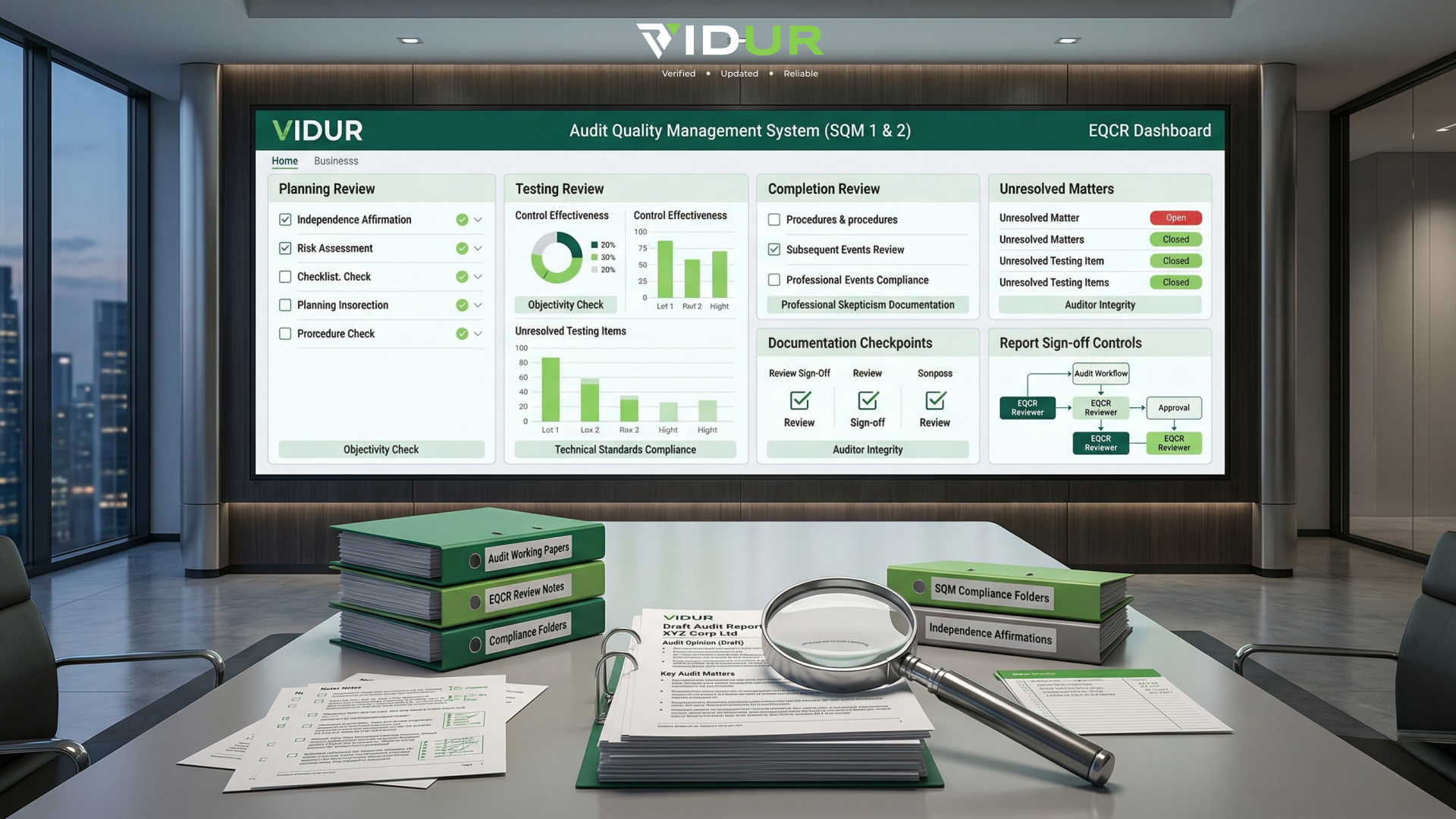
EQCR is an independent checkpoint before the audit report is issued. Its importance has increased under the shift to SQM 1 and SQM 2 from 1 April 2026. The role matters across planning, testing, and completion stages.
Weak reviews often fail because they are late, shallow, checklist-driven, or poorly documented.
For CAs and tax lawyers, audit quality depends on independent challenge, skepticism, timely review, and disciplined documentation.
1. Why EQCR Matters
An Engagement Quality Control review is an objective evaluation of the significant judgments made by the engagement team and the conclusions reached, completed on or before the date of the engagement report. This definition highlights three essentials. First, the review must be objective, meaning the reviewer remains independent of the engagement team. Second, it must focus on significant matters such as material risks, complex estimates, and sensitive judgments. Third, it must be completed before the audit report is issued.
In practice, the audit process follows layered review. The engagement team performs and documents the audit. The engagement partner reviews important judgments. The EQCR then independently evaluates those judgments before the report is released. This makes the EQCR an important quality gatekeeper.
2. The Shift to SQM 1 and SQM 2
The role has gained further importance with the move to a stronger quality management framework. From 1 April 2026, the earlier model in India will be replaced by SQM 1 and SQM 2. These standards introduce a proactive and risk-based approach to quality management. Firms must build systems that provide reasonable assurance that ethical requirements are met, engagements are conducted in accordance with standards and regulations, and reports issued are appropriate in the circumstances.
Within this framework, EQC reviews are especially relevant for audits of listed entities, engagements where law or regulation requires such a review, and assignments where firms identify higher quality risks. These risks may arise from complexity, significant judgment, public interest, prior issues, sensitive reporting matters, or unfamiliar industries.
SQM 2 also sets clear expectations for the reviewer. The EQCR must have technical competence, industry knowledge, relevant experience, independence, objectivity, authority, and enough time to perform a meaningful review. Time is critical. A review done too late weakens its purpose.
3. What the EQCR Reviews Across the Audit Lifecycle
Planning Stage
At the planning stage, the reviewer considers whether the engagement was appropriately accepted, whether adequate resources are available, whether independence has been properly evaluated, and whether the planned audit approach addresses major risks. This includes materiality, fraud risk, group audit scoping, and judgment-heavy matters such as going concern, impairment, provisions, and related parties.
Testing Stage
During the testing stage, the EQCR evaluates whether significant conclusions are supported by sufficient evidence and whether professional skepticism has genuinely been applied. This includes examining management assumptions, significant estimates, compliance risks, fraud indicators, consultations on difficult matters, and communications with those charged with governance. The key question is whether the engagement team has challenged management properly or accepted explanations too easily.
Completion Stage
At the completion stage, the EQCR reviews uncorrected misstatements, their cumulative impact, the financial statements, disclosures, and the draft auditor’s report. The reviewer assesses whether significant judgments are reasonable, supported, and properly documented. Most importantly, the report cannot be dated until the EQC review is complete and significant matters have been resolved.
4. The EQCR Does Not Replace the Engagement Partner
The EQCR does not replace the engagement partner’s responsibility. The engagement partner remains responsible and accountable for managing and achieving quality on the audit. The EQC review does not transfer ownership of complex matters or reduce the partner’s obligations. One leads the engagement, while the other independently challenges its key judgments.
5. Common Weaknesses and the Need for Better Implementation
Common weaknesses continue to appear in EQC reviews. Reviews may happen too late, lack depth, rely too heavily on checklists, or fail to clearly document what was reviewed and concluded. Sometimes significant risks are not linked closely enough to the reviewer’s procedures. These gaps reduce the effectiveness of the review and weaken evidence of professional skepticism.
That is why effective implementation requires early involvement, progressive review, risk-based depth, and strong documentation. The role of the EQCR is also evolving beyond a final reviewer to a broader quality leader who contributes to learning, governance, and accountability within firms.
Conclusion
For CAs and tax lawyers, the message is clear. Audit quality is protected not by process alone, but by independent challenge, timely review, professional skepticism, and disciplined documentation. The EQCR remains one of the strongest pillars of audit integrity.
How Vidur AI Can Help Across These 5 Areas
Vidur AI can support professionals working across these five areas by helping with:
- Independent issue-spotting through faster research on significant and judgment-heavy matters.
- Standards and regulatory readiness through regular legal and tax updates.
- Risk-focused preparation for complex areas involving fraud risk, related parties, materiality, and sensitive reporting issues.
- Better documentation support through drafting capability for structured professional work.
- More consistent judgment through access to 150+ commentaries by renowned authors and research-backed legal and tax knowledge.
For CAs and tax lawyers handling complex matters under increasing scrutiny, Vidur AI can become a practical ally in improving speed, clarity, and confidence.