

A client recently sat across from me, a concerned look on their face. “I keep hearing about this ‘audit trail’ requirement,” he said. “It sounds complicated. What does it actually mean for my business?” It’s a question many are asking. The concept of an audit trail, or edit log, has become a significant point of discussion for both company management and auditors, driven by new compliance and reporting standards. Let’s break down what this means for you.
What is an Audit Trail?
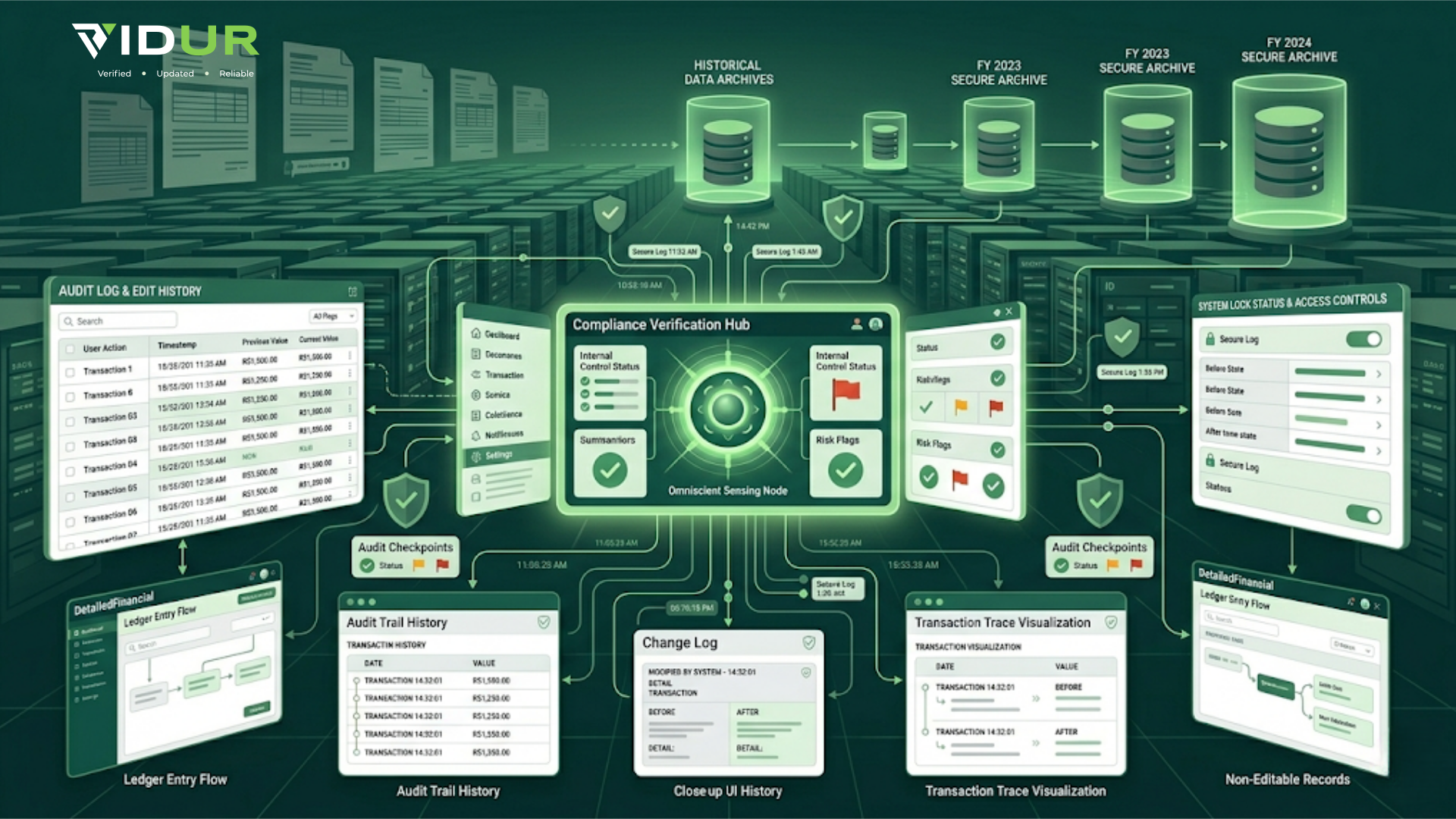
At its core, an audit trail is a chronological, unalterable record of every change made to your company’s financial data. It automatically tracks who made a change, when it was made, and which specific data fields were altered when a record is created, updated, or deleted in accounting software. This creates a transparent and traceable history of all financial transactions.
The Management’s Role: A Proactive Approach
The primary responsibility for implementing and maintaining an audit trail system rests with the company’s management. Any company using accounting software must ensure it has a built-in, non-disposable audit trail feature, applicable to all company forms. This requirement specifically applies to electronic “books of account,” encompassing records of money received and spent, sales, purchases, assets, and liabilities. It does not extend to manually kept records, even if in an electronic format like an Excel spreadsheet; the key is whether the data is housed within the accounting software itself. This applies regardless of whether the accounting function is managed in-house or outsourced; ultimate responsibility for compliance remains with the company’s management.
Key Responsibilities for Management
| Responsibility | Description |
|---|---|
| Determine Books of Account | Identify which records are part of the official “books of account” and maintained within the accounting software. |
| Select Appropriate Software | Choose accounting software with a compliant, non-disposable audit trail feature that captures who, when, and what was changed, and can generate reports. |
| Ensure Proper Functionality | The software must log all changes (creations, modifications, deletions) with a timestamp and user ID, and be able to generate audit trail reports. |
| Outsourcing Considerations | If accounting is outsourced, management must ensure the third-party provider uses compliant software, potentially reviewing independent auditor’s reports. |
| Data Retention | The audit trail, as part of the books of account, must be retained for at least eight financial years, or longer if specific investigations require. |
Failure to comply can result in significant fines, potentially ranging from fifty thousand rupees to five lakh rupees.
The Auditor’s Perspective: Verification and Reporting
Auditors now have a specific mandate to report on the company’s audit trail system. Their role is to verify that compliant accounting software has been used, that the audit trail feature has been active throughout the year for all transactions, has not been tampered with, and that data is preserved according to statutory requirements. This reporting obligation applies to the audit of all companies using accounting software for financial years commencing on or after April 1, 2023, extending to both standalone and consolidated financial statements.
To fulfill this, auditors understand the books of accounts, software used, and whether the function is internal or outsourced. This helps identify potential risks and controls. Risks include a disabled audit trail, unauthorized access, unlogged changes to functionality, incomplete coverage, or direct database modifications. For complex IT environments, experts may be consulted to assure appropriate software use, continuous operation, integrity, and retention of the audit trail. The auditor retains sole responsibility for the audit opinion, even when utilizing experts.
Given that the audit trail requirement applies to every transaction, materiality does not apply to its evaluation; it is a factual reporting requirement. Auditors develop testing plans, combining control and substantive procedures. This includes evaluating controls against unauthorized access or modifications, inquiring about customizations, testing the operating effectiveness of the audit trail feature, and verifying configuration settings to ensure the feature cannot be easily disabled. Testing may involve simulating edits and deletions in a test environment and verifying database edit logs for direct modifications.
Navigating the Challenges
Implementing a robust audit trail system presents challenges. Increased data storage requirements can lead to higher costs, and continuous background tracking may impact system performance. Companies must invest in designing, implementing, and maintaining effective controls, and daily backups become an additional burden.
However, the benefits of a comprehensive audit trail far outweigh these challenges. It provides unprecedented transparency and accountability, aiding in the early detection of anomalies or irregularities that might indicate material misstatements or fraud. The ability to trace every transaction, identifying who made the change and when, significantly enhances financial integrity and regulatory compliance.
Vidur AI and Audit Trail Compliance
In the complex world of tax compliance, having a clear and detailed audit trail is invaluable. This is where a tool like Vidur.AI can be a game-changer. By leveraging its vast repository of knowledge on direct and indirect taxes, Vidur.AI can help you understand the specific audit trail requirements within your industry and ensure your accounting practices are fully compliant. It can assist in analyzing the audit trail data to identify potential red flags and provide guidance on best practices for data retention and security, making the entire process more manageable and less daunting.
Navigate Audit Trail Compliance with Clarity Using Vidur AI
When requirements involve system checks, reporting standards, data retention, and risk evaluation, professionals need quick, reliable guidance—not scattered interpretation.
Vidur AI gives you that support with 150+ professional books and daily updates across direct tax, indirect tax, and corporate law within 24 hours, helping you stay aligned with evolving compliance expectations.
From research and drafting to practical advisory, Vidur AI helps you interpret requirements, respond to audit queries, and manage compliance with greater confidence.
In a compliance environment where every transaction is traceable, Vidur AI helps you stay prepared, precise, and audit-ready.