

Introduction: The Unseen Barrier to Trade
For decades, the narrative of doing business in India has been intertwined with the complexities of its customs administration. While tariffs and trade policies were debated in the open, the on-ground reality for importers and exporters was often a story of long cargo dwell times, unpredictable physical inspections, and a labyrinth of paperwork. This friction at the border, a significant non-tariff barrier, has long been a critical constraint on India’s ambition to become a global manufacturing and trading hub.
Union Budget 2026 marks a pivotal moment in addressing this challenge, not with incremental tweaks, but with a fundamental overhaul of the entire customs ecosystem. The introduction of a comprehensive Trust-Based Customs Framework, powered by the ambitious Customs Integrated System (CIS), represents the most significant operational reform for India’s trade.
The Old Regime: A Legacy of Friction and Delay
To appreciate the magnitude of the proposed change, it is essential to understand the system it seeks to replace. Governed by the Customs Act, 1962, the traditional customs process in India has been largely officer-dependent and adversarial. The default posture was one of suspicion, leading to a high incidence of physical examination of cargo. This had several debilitating effects on the business environment:
- High Dwell Times: As recently as a few years ago, the average container dwell time at Indian ports was significantly higher than global benchmarks.
- Unpredictability: The lack of a transparent, risk-based system meant businesses could not reliably predict clearance times, making it nearly impossible to integrate into just-in-time global supply chains.
- High Transaction Costs: Physical inspections, delays, and complex documentation translated directly into higher transaction costs for businesses, eroding their competitiveness.
The New Framework: A Three-Pillar Transformation
Budget 2026’s response is a multi-pronged strategy designed to re-engineer the entire customs value chain. It rests on three core pillars: Trust, Technology, and Process Re-engineering.
Pillar 1: Trust-Based Governance (The AEO Program)
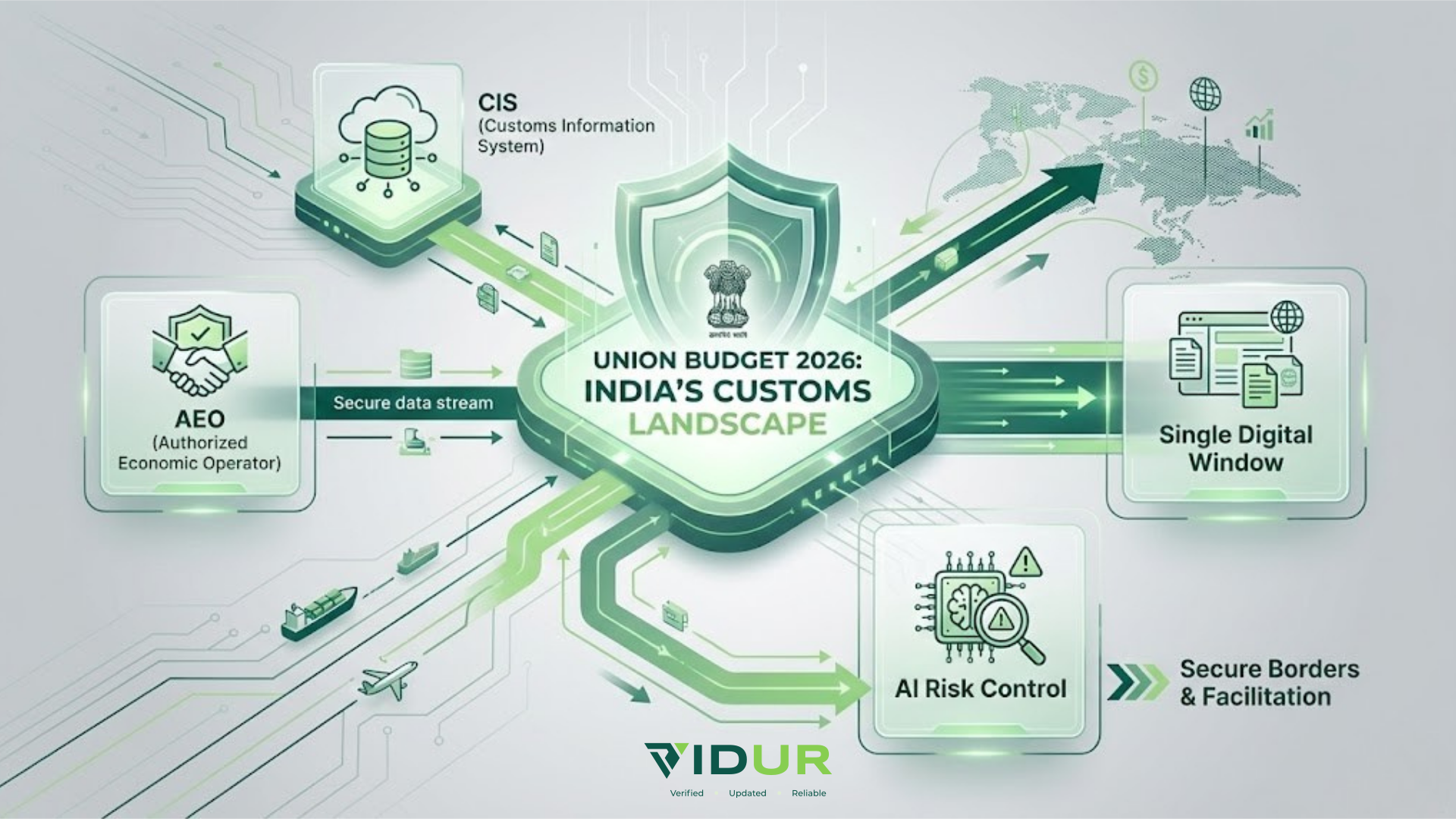
The cornerstone of the new framework is the reinvigoration and empowerment of the Authorised Economic Operator (AEO) program. The AEO certification, a globally recognized quality mark, indicates that a business’s role in the international supply chain is secure and that their customs controls and procedures are efficient and compliant. Budget 2026 provides significant new incentives for AEO-certified entities, effectively creating a ‘green channel’ for trusted traders.
- Key Benefits: The duty deferral period for Tier 2 and Tier 3 AEOs is enhanced from 15 to 30 days, providing significant cash flow benefits. This, combined with reduced inspection rates and faster clearances.
Pillar 2: Technology as the Bedrock (The Customs Integrated System – CIS)
The most ambitious component of the reform is the Customs Integrated System (CIS), a single, integrated, and scalable digital platform for all customs processes, slated for a two-year rollout. This is not merely a digitization of existing processes but a complete technological reimagining of how customs functions.
- AI-Powered Risk Management: The CIS will utilize Artificial Intelligence (AI) and Advanced Imaging to conduct risk assessments. The stated objective is to eventually scan every container at all major ports using non-intrusive methods. This moves the locus of control from individual officer discretion to a data-driven, automated system, promising a level of consistency and objectivity never seen before.
Pillar 3: Process Re-engineering
Supporting the pillars of trust and technology is a series of deep process changes aimed at eliminating redundancies and creating a seamless user experience.
- Single Digital Window: By the end of the financial year, all approvals required for cargo clearance from various Partner Government Agencies (PGAs) like FSSAI, drug controllers, and plant quarantine will be processed through a single, interconnected digital window. This tackles the major bottleneck of inter-agency coordination.
- Immediate Clearance: For trusted importers with a clean record and goods having no specific compliance requirements, clearance will be automated immediately upon online registration and duty payment, a process termed “faceless assessment.”
Impact on Ease of Doing Business: A Critical Analysis
The potential upside of this integrated reform is immense. For businesses, it promises a future of faster turnarounds, lower logistics costs, and greater supply chain predictability. For India, it is a critical step towards becoming a more attractive investment destination and a formidable player in global trade.
However, the path to this future is not without its challenges. The success of this grand vision hinges on flawless execution and addressing some pertinent debates:
- The Digital Divide: While large corporations may have the resources to integrate with the new digital systems, there is a genuine concern about the readiness of MSMEs. Will the government provide the necessary training to promote creation of professionals who will help businesses with tax and compliance work like a para-professional, technological support, and simplified interfaces to ensure that small and medium-sized businesses are not left behind in this digital transformation?
- Implementation and Cybersecurity Risk: The CIS is a massive IT undertaking. Any glitches, downtime, or, more critically, a cybersecurity breach could bring a significant portion of India’s trade to a standstill. A robust, secure, and resilient IT infrastructure is non-negotiable.
- Uniformity Across Ports: A new framework must be implemented with a high degree of standardization to ensure that a shipment cleared in 24 hours at one port does not take 72 hours at another.
Global Benchmarking: Catching Up with the Best
India’s new framework draws inspiration from some of the world’s best trade facilitation systems. The AEO program is part of a global initiative under the World Customs Organization’s SAFE Framework of Standards. The CIS, with its focus on a single window and risk-based scanning, mirrors elements of Singapore TradeNet and the Automated Commercial Environment (ACE). The key differentiator for India will be the scale of its implementation and its ambitious goal of scanning every container using AI. If successful, India will not just be catching up with global best practices but will be setting a new benchmark for a trade ecosystem of its size and complexity.
Conclusion: A Bold Blueprint for a Trading Superpower
The Trust-Based Customs Framework announced in Budget 2026 is more than just a policy update; it is a bold blueprint for India’s future as a trading superpower. It represents a fundamental shift in mindset—from control to facilitation, from suspicion to trust, and from manual processes to intelligent automation. The potential benefits in terms of enhanced EODB, reduced logistics costs, and improved global competitiveness are undeniable.
However, the journey from blueprint to reality will be a marathon, not a sprint. It will require sustained political will, flawless technological execution, and a collaborative approach between the government and the trade community. For tax professionals and business advisors, the immediate task is to understand the nuances of this new framework, guide businesses towards AEO certification, and prepare for a future where the speed of trade is determined not by the length of a queue, but by the integrity of a digital footprint in the digital world.