

A CA received a frantic call from his client, a proprietary trader, minutes after the Sunday budget session ended.
“Did she really just more than double the futures tax?” the client asked, his voice tight.
“My entire strategy just became unviable.”
The CA had been watching the same numbers flash across his screen.
“Yes. And it’s effective immediately.”
If you fielded similar calls on February 1, 2026, you witnessed one of the sharpest policy pivots in India’s capital markets history. What looked like a minor tax tweak—a few basis points here and there—triggered a market bloodbath that erased over ₹6 lakh crore in investor wealth in a single session.
What Is STT, Really?
Securities Transaction Tax isn’t new. Introduced in 2004, it’s a direct tax levied on every buy and sell transaction on recognized stock exchanges—equity shares, futures, options, the works. It’s deducted upfront, regardless of whether you profit or lose. Think of it as the cost of playing the game.
For nearly two decades, STT rates remained relatively stable. Traders factored it into their cost structures. High-frequency players optimized around it. It was predictable. Until it wasn’t.
The Numbers That Broke the Market
Budget 2026 didn’t just nudge STT rates—it detonated them:
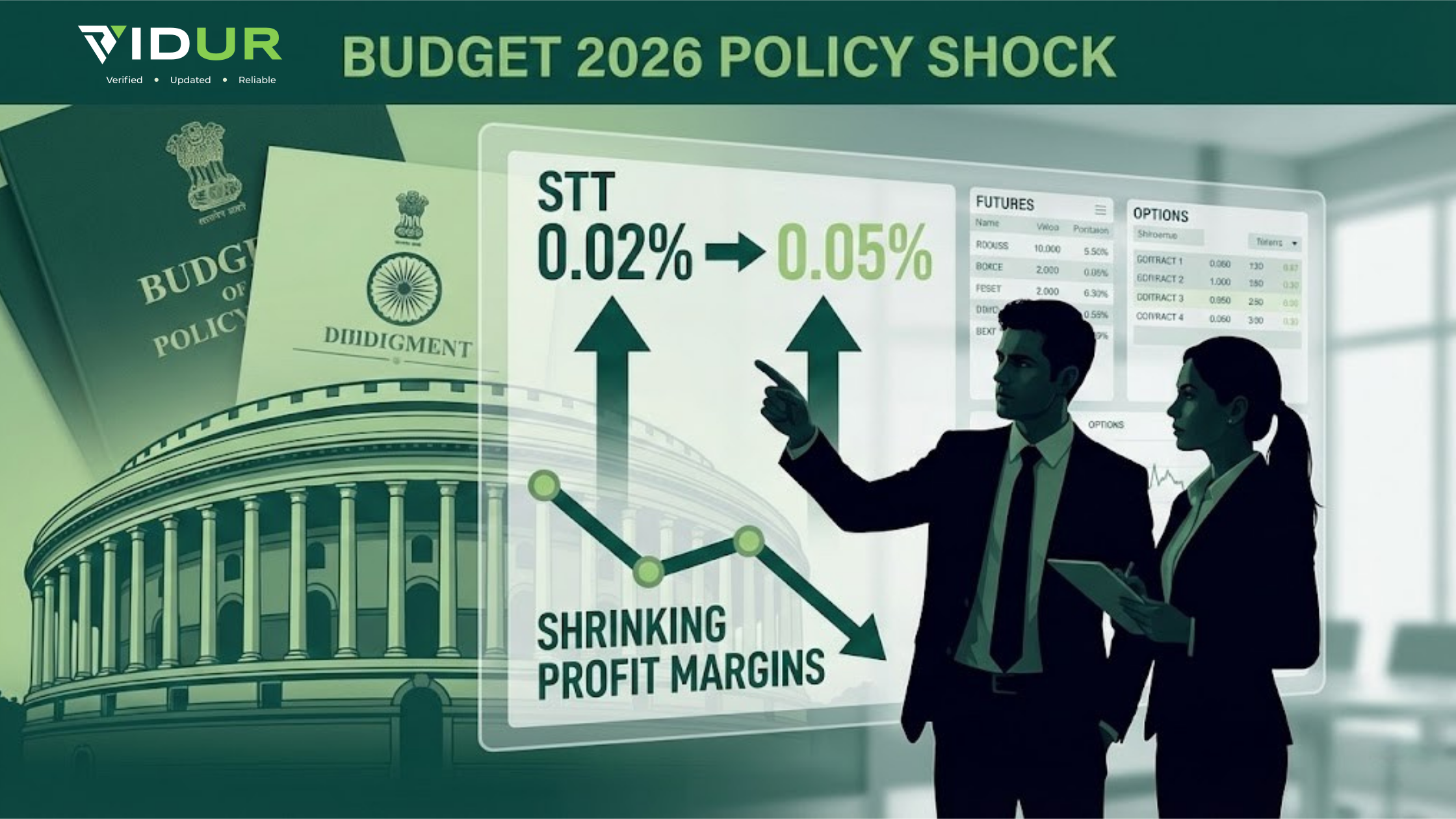
- Futures: 0.02% → 0.05% (150% increase)
- Options Premium: 0.1% → 0.15% (50% increase)
- Options Exercise: 0.125% → 0.15% (20% increase)
On paper, these look like rounding errors. In practice, they’re seismic.
Consider a futures contract worth ₹1 lakh. Earlier, you paid ₹20 in STT. Now it’s ₹50. For a single trade, that’s manageable. But high-frequency traders execute hundreds or thousands of trades daily. Arbitrageurs operate on razor-thin margins measured in basis points. For them, this isn’t a speed bump—it’s a wall.
Why the Government Pulled the Trigger
The Finance Minister’s justification was blunt: curb speculation. Data from Securities and Exchange Board of India shows nine out of ten retail F&O traders lose money. The derivatives segment had seen what regulators called an “unchecked explosion” of retail participation.
The government framed the STT hike as a course correction—making frequent short-term trades less attractive while generating additional revenue from high-volume trading.
The subtext? Nudge retail investors away from derivatives and back toward the cash market. Encourage long-term investing over short-term speculation.
The Immediate Carnage
Markets don’t wait for nuance. The announcement triggered panic selling, especially in stocks tied to trading volumes. Broking firms with heavy derivatives exposure took the hardest hits:
- Groww plunged 13%
- Angel One fell 11%
- Anand Rathi, Nuvama, and Motilal Oswal slipped 8%, 6%, and 3% respectively
- Bombay Stock Exchange itself dropped 8%
The Sensex fell over 2,000 points. Nifty skidded below 25,000. It was a special Sunday trading session—and it turned into a rout.
Who Actually Gets Hurt?
High-Frequency and Algo Traders
These players are liquidity providers operating on thin margins with high turnover. A 150% STT increase on futures fundamentally alters their economics. Many will recalibrate strategies; some may exit entirely.
Arbitrageurs
They profit from price discrepancies across markets or instruments. When transaction costs rise, arbitrage opportunities shrink or disappear. Less arbitrage means less efficient price discovery.
Hedgers
Corporates and institutional investors use derivatives to manage risk—currency exposure, commodity price fluctuations, equity portfolio protection. Higher STT increases hedging costs, making risk management more expensive.
Broking Firms
Derivatives contribute 70–80% of broking income for many firms. Lower volumes mean lower revenue while fixed operating costs remain unchanged. Margins get squeezed.
Who Might Not Care?
Long-term foreign portfolio investors, according to market veterans. These investors hold positions for years, not seconds. Transaction taxes don’t materially impact their return calculations. They focus on fundamentals—economic growth, corporate profitability, governance.
As one exchange CEO noted, most FPIs aren’t high-frequency players. Once they buy, they stay invested for years. For them, a few basis points in STT aren’t decision drivers.
The Liquidity Debate
Here’s where it gets contentious. Critics argue derivatives aren’t just speculative arenas—they’re liquidity engines. They facilitate price discovery in the cash market. When derivatives volumes decline, cash market liquidity often follows.
Reduced liquidity means higher costs of capital. Higher costs make India less competitive for global flows.
Foreign equity outflows already topped ₹36,000 crore in January 2026. The STT hike further erodes post-tax returns, potentially pushing derivative-oriented foreign flows toward rival Asian markets—Taiwan, Korea, Singapore—just as India needs to deepen market liquidity.
Others counter that futures are margined, risk-managed products. The real retail excess happens elsewhere. Whether higher STT will actually deter speculation or simply weigh on participation and competitiveness remains an open question.
What This Means for Practice
- Active F&O clients: Break-even points have shifted. Strategies viable at 0.02% futures STT may not survive at 0.05%.
- Proprietary traders and hedge funds: Re-model cost structures against historical performance. Expect strategy attrition.
- Corporate hedgers: Reassess derivatives-based risk management versus natural hedges or operational adjustments.
- Retail options traders: This is a natural inflection point to reassess suitability, risk appetite, and investment horizon.
The government has sent a clear signal: it wants less speculation and more long-term investing. Whether the market listens—or simply adapts—will unfold over the coming quarters.