

“The Artificial Intelligence (AI)-powered analytics tool flagged a series of unusual, round-number transactions processed outside of business hours,” a junior auditor reported to his manager. “But management has provided a logical explanation for them. Should we just clear it?”
The audit manager paused. “The tool did its job by finding the anomaly. Now we do ours! The explanation seems plausible, but our role isn’t just to trust; it’s to scrutinize. Let’s dig deeper, corroborate the story with independent evidence, and challenge the assumptions. In today’s world, skepticism is our most important tool.
This scenario captures the fundamental evolution of the auditor’s role. The classic metaphor of the auditor as a passive “watchdog” is no longer sufficient. A history of high-profile corporate scandals and the increasing complexity of business have forged a new expectation: the auditor as an active, professional skeptic.
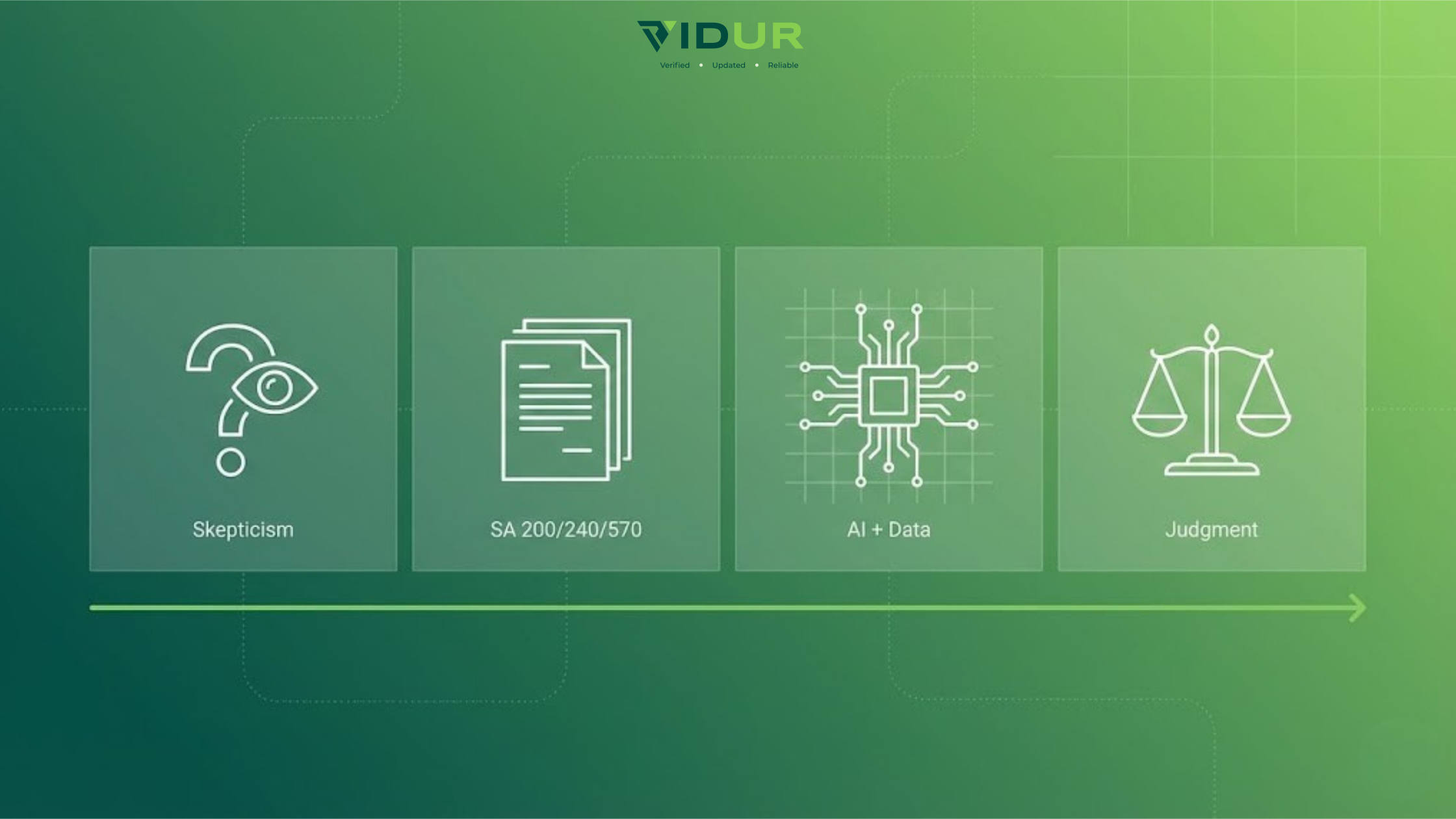
Here are four pillars that define this modern mindset:
1. From Watchdog to Skeptic: A Necessary Evolution
The traditional “watchdog” role, famously articulated by Lord Denning, presumed management’s honesty and focused on verifying records with reasonable care. This passive approach proved inadequate in the face of sophisticated financial manipulation. These events demonstrated that auditors who simply “trust, but verify” can become unwitting accomplices to fraud. In response, auditing standards globally have embedded professional skepticism as a core requirement. This is not about being cynical; it is an attitude that includes a questioning mind and a critical assessment of audit evidence, recognizing that management bias or fraud is always a possibility.
2. Key Standards Demanding a Skeptical Approach
Professional skepticism is no longer an abstract concept; it is a codified obligation woven into the fabric of modern auditing standards.
Standards Requiring Professional Skepticism
| Standard | Key Requirement for Skepticism |
|---|---|
| SA 200 | Requires auditors to plan and perform the entire audit with professional skepticism, challenging assumptions and not blindly trusting information. |
| SA 240 | Obligates auditors to remain alert to the risk of fraud throughout the audit, distinguishing between fraud and error, and recognizing that management can override controls. |
| SA 570 | Demands a skeptical assessment of a company’s ability to continue as a going concern, challenging management’s forecasts and assumptions about future viability. |
These standards shift the auditor’s role from a reactive reviewer to a proactive challenger, responsible for critically evaluating the evidence before them.
3. Technology: The Auditor’s New Magnifying Glass
The rise of AI and advanced data analytics has revolutionized the audit process. These technologies act as a powerful magnifying glass, enabling auditors to:
- Analyze 100% of Transactions: Move beyond sampling to examine entire populations of data, identifying outliers and anomalies that would be impossible to find manually.
- Identify Hidden Patterns: Use machine learning to detect unusual trends or correlations that could indicate fraud or error.
- Predict Future Risks: Employ predictive analytics to gain insights into potential future misstatements, allowing for preemptive action.
However, technology is a tool for detection, not a replacement for judgment. The modern auditor must apply skepticism not only to the financial data but also to the technology itself, questioning the algorithms, validating the data sources, and interpreting the results with a critical eye.
4. The Human Element: Judgment in an AI-Powered World
While AI can identify what is unusual, it cannot explain why. That remains the domain of human intelligence and professional judgment. An AI tool can flag an anomaly, but it is the skeptical auditor who must investigate the root cause, challenge management’s explanations, and draw a conclusion based on corroborated evidence. The future of auditing lies in the powerful combination of technology-driven detection and human-driven skepticism. The auditor’s role is not diminished by AI but elevated, shifting from manual data crunching to higher-level analysis, critical thinking, and investigation.
The New Mandate for Auditors
The journey from a passive watchdog to an active professional skeptic reflects the profound changes in the business world. In an environment of increasing complexity and technological advancement, the auditor’s core responsibility is to justify the trust placed in them not by passive observation, but by applying informed, critical, and skeptical judgment at every stage of the audit.
Ready to navigate the complexities of modern legal and financial compliance with confidence? Discover how Vidur AI can empower your practice with intelligent, AI-driven insights.