

“The board is asking for assurance on our Business Responsibility and Sustainability Report (BRSR) this year,” the CFO explained to the lead audit partner. “They’re also questioning why we aren’t using more advanced data analytics to catch potential fraud in our e-commerce division. Are these things part of the standard audit now?”
The audit partner nodded. “They are quickly becoming so. Stakeholder expectations have shifted. The audit is no longer just about historical financial data. It’s about providing trust and assurance across a much broader landscape, from ESG metrics to the integrity of your IT environment. We’re moving beyond the traditional balance sheet into new frontiers.”
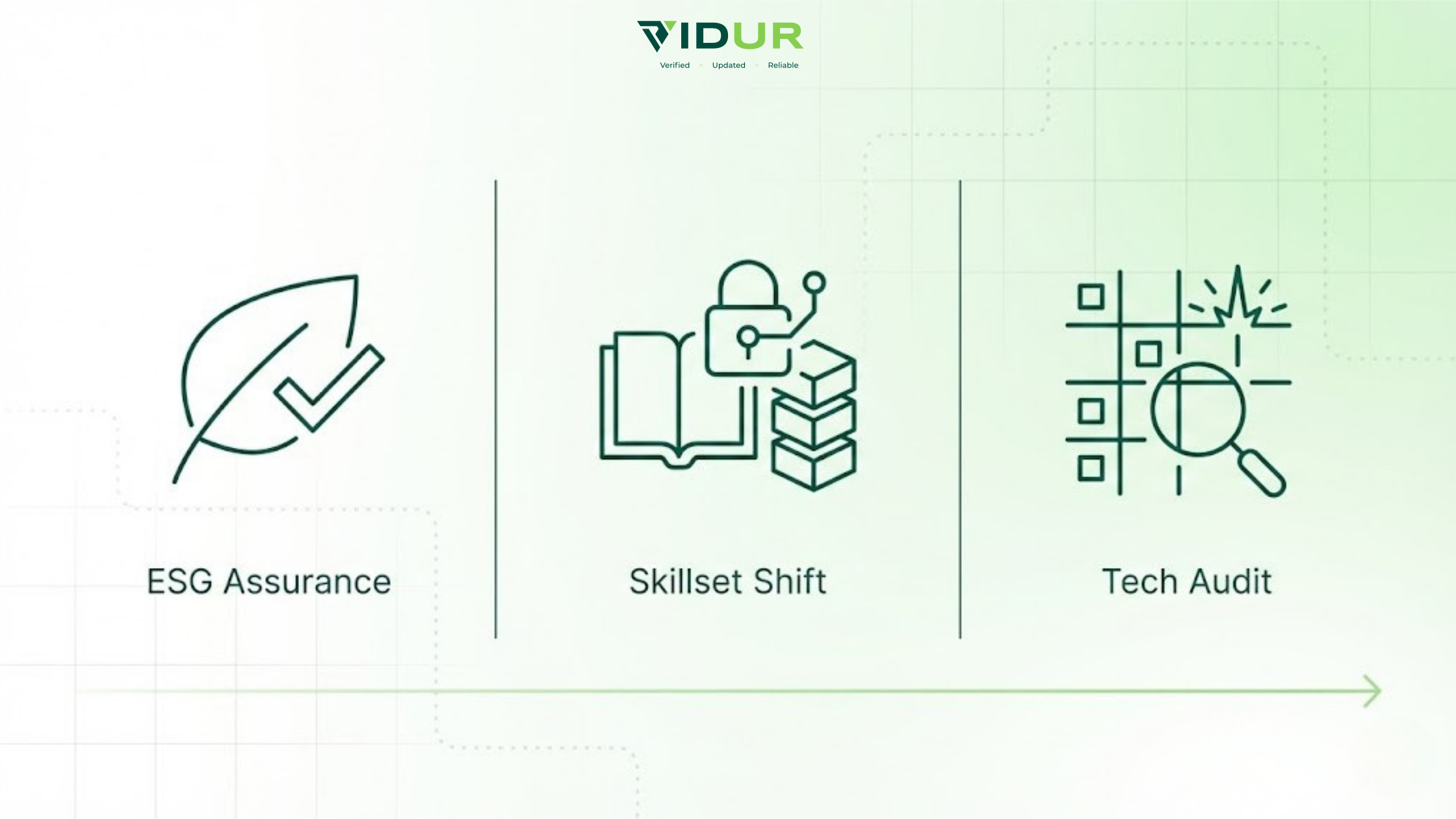
This conversation is becoming the norm in boardrooms across India. The role of the auditor is undergoing a seismic shift, driven by two powerful forces: the explosion of technology and the urgent demand for credible non-financial reporting, particularly around Environmental, Social, and Governance (ESG) criteria. For tax professionals, understanding these new expectations is not just important; it is essential for survival and growth. Here are the three new frontiers shaping the future of audit.
1. The ESG Assurance Mandate: Auditing What Matters
Financial performance is no longer the only metric that matters. With the introduction of frameworks like the BRSR in India, there is a growing demand for independent assurance on non-financial information. Stakeholders, from investors to regulators, want to know that a company’s ESG disclosures are as reliable as its financial statements.
This expands the auditor’s role significantly, requiring them to provide assurance on a wide array of metrics.
ESG Assurance Areas for Auditors
| ESG Pillar | Examples of Assurance Areas for Auditors |
|---|---|
| Environmental | Verifying data on carbon emissions, water scarcity initiatives, waste management, and energy efficiency. |
| Social | Assessing disclosures related to data protection, employee diversity, labor standards, and human rights in the supply chain. |
| Governance | Reviewing the effectiveness of board composition, audit committee oversight, anti-bribery controls, and whistleblower schemes. |
The auditor is now expected to bring the same level of rigor, consistency, and professional skepticism to these ESG metrics as they do to the financial accounts, ensuring the information is credible and trustworthy.
2. The Auditor’s Evolving Skillset: From Accountant to Polymath
These two forces—technology and ESG—are fundamentally reshaping the auditor’s required skillset. The traditional audit focused on accounting principles and financial verification. The audit of the future requires much broader and more integrated expertise.
How the Auditor Role is Changing
| Aspect | The Traditional Auditor | The Future-Ready Auditor |
|---|---|---|
| Primary Focus | Historical financial statements | Financials, ESG data, IT controls, and forward-looking risks |
| Core Tools | Manual ledgers, calculators, sampling | AI, data analytics, continuous auditing tools, LLMs |
| Key Skills | Accounting standards, tax law, financial math | Accounting standards, tax law, Data science, cybersecurity, sustainability frameworks, critical thinking |
3. The Tech-Infused Audit: From Sampling to Full-Spectrum Analysis
The expectation for auditors to be tech-savvy has moved from a “nice-to-have” to a core competency. Stakeholders now assume that auditors are leveraging technology to deliver a more effective and insightful audit. This is no longer about simply using audit software; it’s about embedding advanced technology into the very fabric of the audit process.
- Data Analytics and Artificial Intelligence (AI): Instead of relying on small samples, auditors are now expected to use data analytics to scrutinize entire populations of transactions. AI and machine-learning models can flag anomalies that are invisible to the human eye, such as duplicate payments, round-number invoices, or transactions processed at unusual times. This allows for a more robust and proactive approach to identifying potential fraud and control weaknesses.
- Leveraging Large Language Models (LLMs) for Insight: Even LLMs have become an audit tool. A practitioner can gain valuable insights by asking an LLM to analyze analyst reports and management responses. Repeated questions from the investment community about a company’s large cash balance or high receivables, for instance, can signal a high-risk area that warrants deeper investigation by the auditor.
This evolution demands that auditors become practitioners with a deep understanding not only of accounting but also of technology, data science, sustainability, and complex risk management. It is a transformation from a financial watchdog to a holistic assurance provider.
Ready to navigate the complexities of modern legal and financial compliance with confidence? Discover how VIDUR AI can empower your practice with intelligent, AI-driven insights.
Try VIDUR AI