

“I feel like we’re constantly just trying to keep our head above water,” my client, the founder of a promising auto components MSME, confessed during our post-budget review. “Between chasing payments, managing compliance, and trying to find capital to expand, there’s hardly any time left to actually innovate. What’s in this budget for us, the smaller players?”
It’s a story I hear all too often. The MSME sector, the backbone of our economy, has long been caught in a cycle of survival. But as I walked him through the provisions of the Union Budget 2026-27, it became clear that this year marks a pivotal change in strategy. The government isn’t just offering lifelines; it’s providing a launchpad.
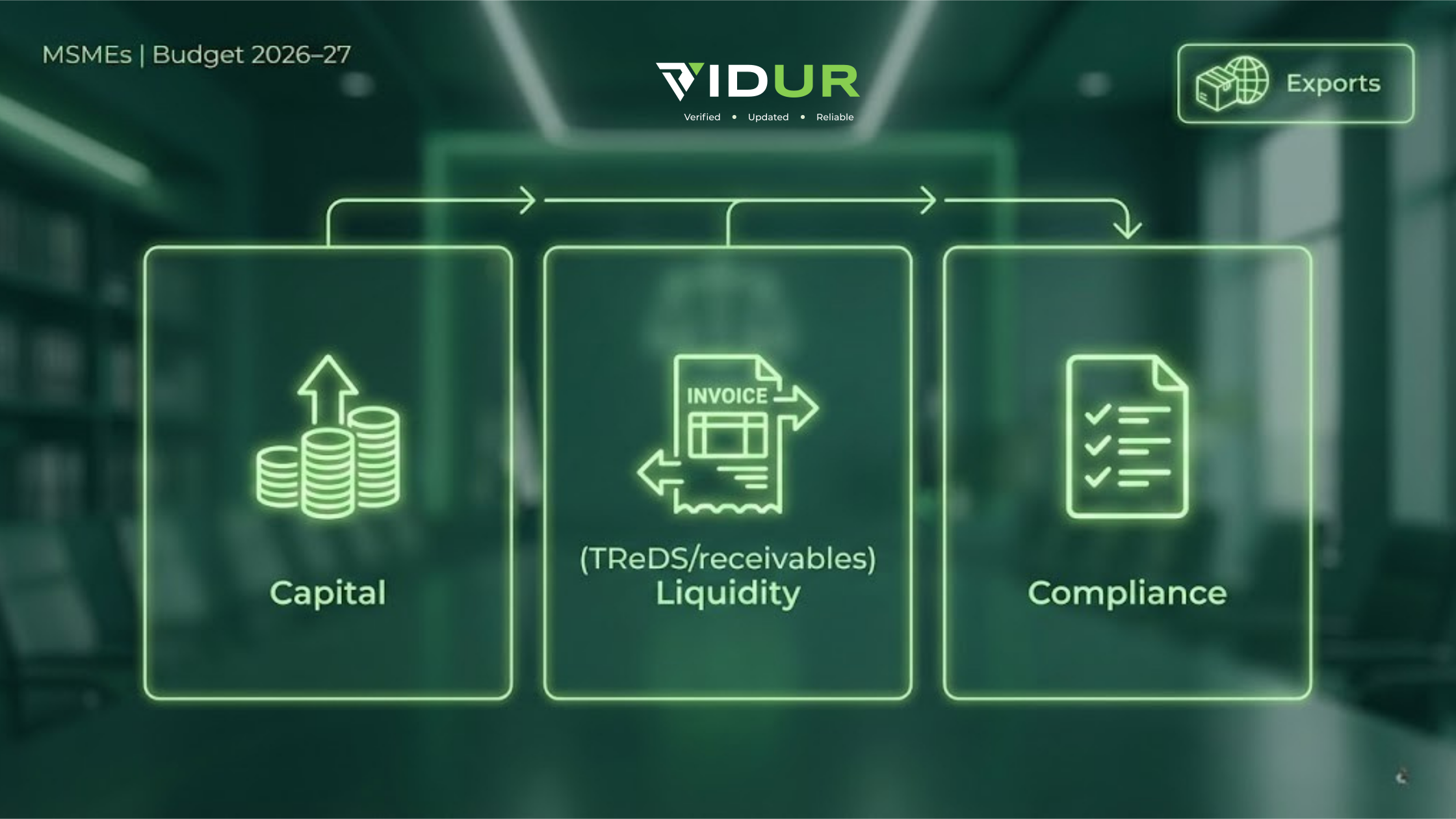
“This budget isn’t about survival,” I explained. “It’s about giving you the tools to compete, grow, and thrive on a larger stage. The focus is on a comprehensive three-pronged strategy: injecting capital, solving the liquidity puzzle, and providing affordable professional support.”
A Multi-Faceted Approach to Empowering MSMEs
For years, the biggest hurdles for any small business have been access to timely finance and the crushing weight of compliance costs. The latest budget tackles these issues head-on with a series of well-defined, interconnected reforms. The goal is no longer just to sustain MSMEs, but to cultivate them into ‘Champions’ with the potential for global reach.
This is evident in the direct financial support being offered, but more importantly, in the structural changes being made to the financial ecosystem. The government is creating pathways for MSMEs to unlock the value tied up in their own operations, turning receivables into ready capital and leveraging technology to level the playing field.
Key MSME Reforms at a Glance
To understand the full impact, it’s best to see the key initiatives together. This isn’t a scattered list of benefits; it’s a coordinated strategy to address the core challenges faced by the sector:
| Pillar of Support | Specific Initiative | Direct Benefit for MSMEs |
|---|---|---|
| Equity Support | A new, dedicated ₹10,000 crore SME Growth Fund to incentivize and create future champions. | Access to growth capital for expansion, technology adoption, and market diversification. |
| Micro-Enterprise Aid | ₹2,000 crore top-up to the Self-Reliant India Fund to continue providing risk capital. | Crucial funding access for the smallest businesses to scale up and formalize their operations. |
| Liquidity & Cash Flow | TReDS mandate for all purchases from MSMEs by CPSEs, creating a benchmark for the private sector. | Faster and more reliable payment cycles, drastically reducing the problem of delayed payments. |
| Credit Access | Credit Guarantee (CGTMSE) support for invoice discounting on the TReDS platform. | Easier access to working capital loans from banks and NBFCs against confirmed invoices. |
| Professional Support | Professional bodies (ICAI, ICSI) to develop a cadre of ‘Corporate Mitras’ in Tier-II & III towns. | Affordable, on-demand professional help for meeting compliance requirements without high costs. |
| Global E-commerce | Complete removal of the ₹10 lakh value cap on courier exports. | Enables small businesses, artisans, and start-ups to seamlessly sell their products in global markets. |
Solving the Liquidity Puzzle, One Reform at a Time
The most transformative aspect of this budget for MSMEs is the laser focus on solving the cash flow problem. Mandating the use of the Trade Receivables Discounting System (TReDS) for government purchases is a masterstroke. It not only ensures timely payments from public sector units but also sets a powerful precedent for corporate India.
By introducing a credit guarantee mechanism for invoice discounting and allowing TReDS receivables to be used as asset-backed securities, the budget is creating a vibrant secondary market for MSME debt. This means more liquidity, better pricing, and a fundamental shift in how working capital is accessed.
Linking the Government e-Marketplace (GeM) with TReDS further de-risks lending to MSMEs with government contracts, making them more attractive to financiers.
The Evolving Role of the Strategic Advisor
As my client began to see the interconnected nature of these reforms, his perspective shifted from anxiety to ambition. “So, you’re saying I can use my government orders to get faster, cheaper loans, and I can hire a ‘Corporate Mitra’ to handle my GST filings without breaking the bank?” he asked, a new energy in his voice.
“Exactly,” I replied. “And you can export smaller, high-value consignments without worrying about a value cap.”
This is the new reality for MSMEs. The challenge for us, as their trusted advisors, is to evolve with this landscape. Our role is no longer confined to audits and tax returns. We must become strategic partners who can help our MSME clients navigate these new funding avenues, leverage these compliance-easing measures, and build a roadmap for growth.
The firms that succeed will be those that use technology and deep expertise to translate these policy tailwinds into tangible business momentum, truly helping the backbone of our economy to stand tall on the global stage.