

The aroma of freshly brewed coffee filled the air as CA Ananya Sharma meticulously reviewed her client’s financial projections. Her client, a dynamic startup founder, leaned forward, a hint of anxiety in his voice.
“Ananya, with the Budget just around the corner, what’s your gut feeling? Will we see the tax reforms we’ve been hoping for, or another year of navigating complex ambiguities?”
Ananya smiled reassuringly.
“The upcoming Budget 2026–27 isn’t just another fiscal announcement. It’s poised to be a blueprint for India’s economic trajectory, and for us, it means anticipating seismic shifts.”
As India marches towards its ambitious economic goals, the Union Budget 2026–27, set to be unveiled on February 1, 2026, is more than a mere financial statement; it’s a strategic declaration. For Chartered Accountants and tax lawyers, this isn’t just about compliance; it’s about foresight, strategic advisory, and mastering an evolving regulatory landscape.
The whispers from North Block, coupled with industry demands and economic imperatives, paint a picture of a Budget that will redefine the playing field. Amidst a global economic landscape characterized by volatility, the budget is expected to adopt a forward-thinking approach that reinforces investor confidence and catalyses private sector participation.
Here are the game-changing expectations every astute professional must prepare for.
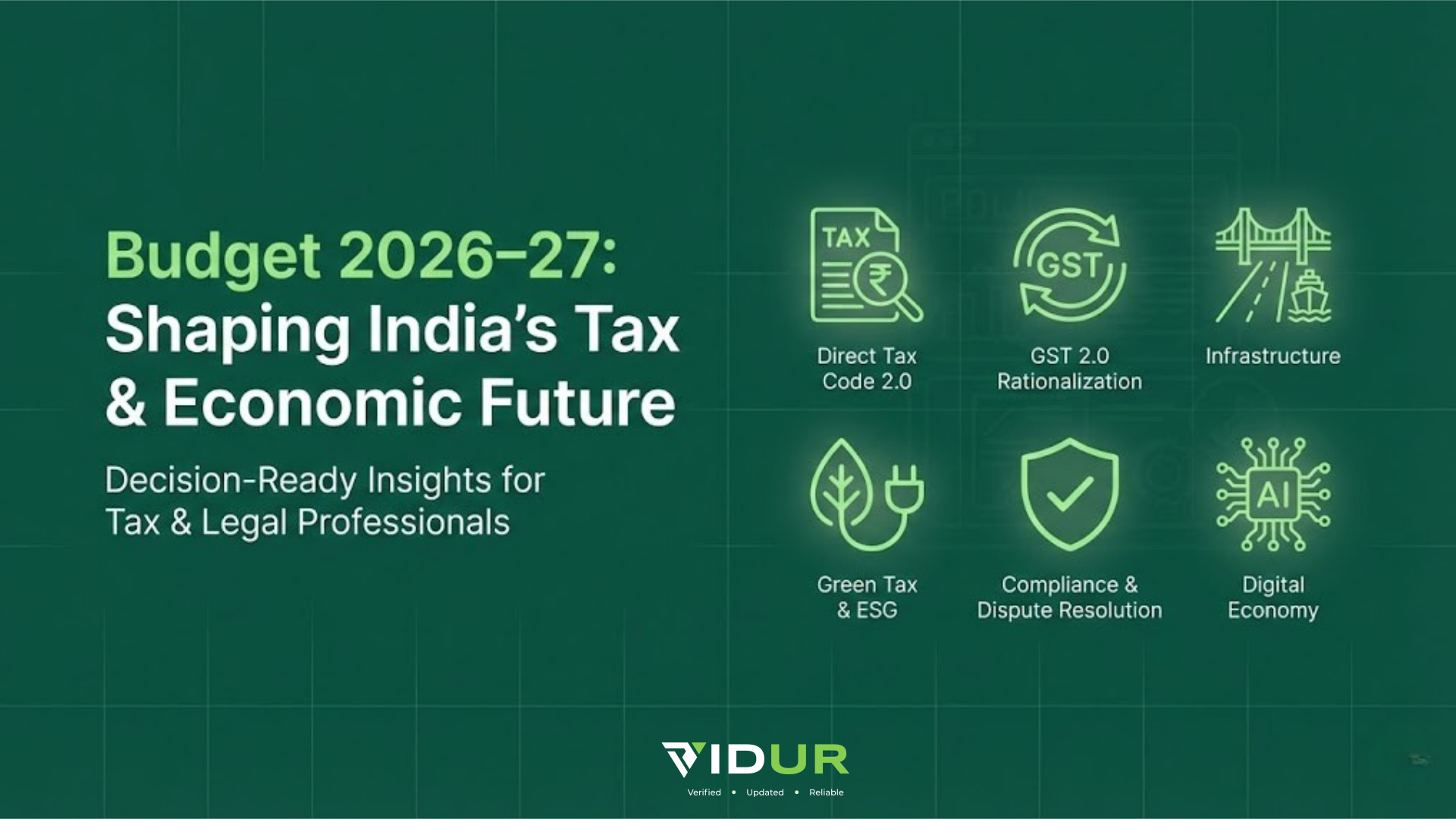
1. Direct Tax Code (DTC) 2.0: The Simplification Imperative
The long-anticipated overhaul of direct tax laws is expected to gain significant momentum. The Budget is likely to introduce key provisions aimed at simplifying the tax structure, reducing litigation, and fostering a more taxpayer-friendly regime.
Market sentiment strongly indicates a need for rationalization in several key areas. For instance, with 37 different types of payments to residents where TDS rates vary from 0.1% to 30%, the TDS provisions have become a fertile ground for disputes.
There is a strong expectation that the budget will lay down a roadmap for the rationalization of the TDS rate structure with no more than three to four rates. Furthermore, to ensure a seamless transition to the new Income Tax Act, the government is expected to provide detailed guidelines and FAQs to minimize confusion and avoid litigation.
2. Capital Gains Tax Rationalization: Fueling Investment
Expectations are high for a rationalization of the capital gains tax regime, involving adjustments to holding periods, recalibration of tax rates, and potentially a re-evaluation of indexation benefits.
The goal is clear: to stimulate investment across various financial instruments, aligning India’s capital markets with global best practices. A recent survey of industry professionals revealed that 50% believe the capital gains tax regime is one of the top three areas requiring the most attention and further rationalization.
3. GST 2.0: Further Streamlining and Rate Rationalization
The Goods and Services Tax (GST) regime is ripe for its next phase of evolution. Budget 2026–27 is anticipated to address long-standing demands for further rate rationalization, potentially reducing the number of slabs and simplifying classification disputes.
An overwhelming 82% of businesses have highlighted the need to review the existing Invoice Management System (IMS) framework and provide enhanced reconciliation capabilities to reduce the increasing number of mismatches and rejections in credit notes.
Moreover, there is a growing call for a one-time settlement scheme under Customs Law, similar to the successful Sabka Vishwas scheme, to facilitate the resolution of pending disputes.
4. Boost for Manufacturing and PLI Schemes
In line with the Make in India initiative, the Budget is likely to offer enhanced incentives for domestic manufacturing. This could translate into expanded Production Linked Incentive (PLI) schemes, with strong recommendations to extend them to new technology sectors such as AI, space, and robotics.
To further boost investment and stimulate growth in the manufacturing sector, there is a strong case for reintroducing accelerated depreciation as a targeted fiscal incentive. This could be made available as part of the existing concessional corporate tax regime of 22% / 15% without triggering the Minimum Alternate Tax (MAT).
5. Green Tax Initiatives and ESG Push
With a growing global focus on sustainability, the Budget is expected to introduce green tax measures, incentivizing eco-friendly practices and penalizing polluting industries.
This could include tax breaks for renewable energy adoption, carbon credits, and a broader push for Environmental, Social, and Governance (ESG) compliance. A specific recommendation gaining traction is the provision of 200% green credits for investments in renewable energy.
6. Digital Economy and AI Taxation Framework
The rapid expansion of the digital economy and Artificial Intelligence (AI) necessitates a robust tax framework. The Budget might lay the groundwork for taxing digital services more effectively, addressing issues of permanent establishment in the digital age, and offering incentives for AI research and development within India.
There is also a pressing need for a clear legal framework for the taxation of cryptocurrencies and NFTs, including guidelines on the treatment of losses incurred.
7. MSME Sector Support and Employment Generation
The MSME sector is likely to receive significant attention. Expect measures such as easier access to credit, extended tax benefits, and simplified compliance procedures.
To incentivize organizations to generate new employment opportunities, a noteworthy suggestion is to increase the monthly employee cost limit for deduction from INR 25,000 to INR 1,00,000.
8. Infrastructure Spending and Innovative Financing Models
Continued robust investment in infrastructure is a given, with substantial allocations expected for roads, railways, ports, and urban development.
However, focus is expected to shift from mere funding to quality execution and timely completion, including a rethink of the L1 procurement approach. The budget may also enable a broader ecosystem of financial products such as guarantee instruments, insurance products, currency hedging solutions, and credit enhancement mechanisms for infrastructure bonds.
9. Personal Income Tax Relief: Boosting Consumption
While simplification remains a broader goal, expectations of relief for the salaried class persist. A significant 73% of respondents believe the standard deduction should be increased from the current INR 75,000.
10. International Taxation: Navigating Global Shifts
India’s approach to global minimum tax (Pillar Two) and OECD initiatives will be crucial. The Budget may introduce legislative changes to align with global frameworks.
There is strong demand for codified rules on Permanent Establishment (PE) and profit attribution. Additionally, with the IFSC completing a decade, 51% of industry experts expect a safe harbour regime for IFSC structures.
11. Enhanced Digital Compliance and Data Analytics
The government’s digital governance push is expected to continue with deeper integration of AI-driven scrutiny and data analytics.
While 53% of organizations extensively use technology for compliance, 40% still rely on manual processes, highlighting the need for further digital adoption.
12. A Renewed Focus on Dispute Resolution
Tax litigation remains a significant concern. Expectations include a time-bound Customs Amnesty Scheme, mandatory timelines for disposal of income-tax appeals, and revamping the Dispute Resolution Panel (DRP), which 50% of respondents consider ineffective.
13. Reforming the Transfer Pricing Regime
The Transfer Pricing regime is ripe for reform. 75% of respondents support introducing applicability thresholds and revising documentation limits unchanged since 2002.
Further, 71% of professionals advocate revamping safe harbour rules, especially margin and threshold structures.
14. Sector-Specific Expectations for a Targeted Boost
Key sectoral recommendations include:
- Retail: Online module for Bill of Entry amendments linked with GST returns
- Aerospace & Defence: Tax exemptions for simulation devices and ground support equipment
- Chemicals: Reinstatement of R&D incentives and 200% green credits
- TMT: ITC on excluded services and centralized GST registration
- Financial Services: IFSC tax holiday extension and pass-through for Special Situation Funds
- Life Sciences: Expanded patent box benefits and 200% R&D deduction
Comparative Overview: Key Budgetary Shifts
| Aspect | Pre-2026 Approach (Illustrative) | Post-2026 Budget Outlook (Expected) |
|---|---|---|
| Direct Tax Structure | Complex, litigation-prone | Simplified slabs, rationalized TDS |
| Capital Gains | Varied holding periods | Streamlined, investment-friendly |
| GST | Multiple slabs | Fewer slabs, improved ITC |
| Digital Economy Tax | Ad-hoc measures | Structured AI & digital framework |
| Compliance | Partial digitization | Fully digital, AI-driven |
| Dispute Resolution | High pendency | Amnesty schemes, timelines |
| Transfer Pricing | Low thresholds | Revised thresholds & safe harbours |
Embrace the Future of Tax Advisory
The upcoming Budget 2026–27 is a strategic inflection point. For tax and legal professionals, staying ahead means leveraging technology-driven insights to interpret reforms, advise decisively, and convert regulatory change into strategic advantage.
The future of tax advisory will belong to those who combine regulatory vigilance, strategic foresight, and decision-ready intelligence